










There is a very specific moment that defines first contact with the Escalade IQ. It happens right after you walk up to it, take in the size, the lighting, the presence… and then open the door and see that massive screen stretching across the entire dashboard. In that moment, it feels like Cadillac figured it out.
This thing has a 205 kWh battery, up to 750 hp (559 kW), and around 460 miles of range. Those are the kinds of numbers that make you stop comparing it to other Escalades and start comparing it to, well, basically, everything else on sale. Because on paper, it’s not just competitive. It’s dominant.
And honestly, for a little while, it lives up to that promise. It feels expensive. It feels thought-out. It feels like something you worked toward. Then you spend real time with it.
Quick Facts
SWIPE
And instead of one big “wow” moment, you start getting a series of smaller realizations. Some are impressive. Some are confusing. Some make you wonder what ownership is actually going to look like a few years down the road. That’s where the Escalade IQ really starts to reveal itself.
Modern Styling Without Losing The Plot
Photos Stephen Rivers / Carscoops
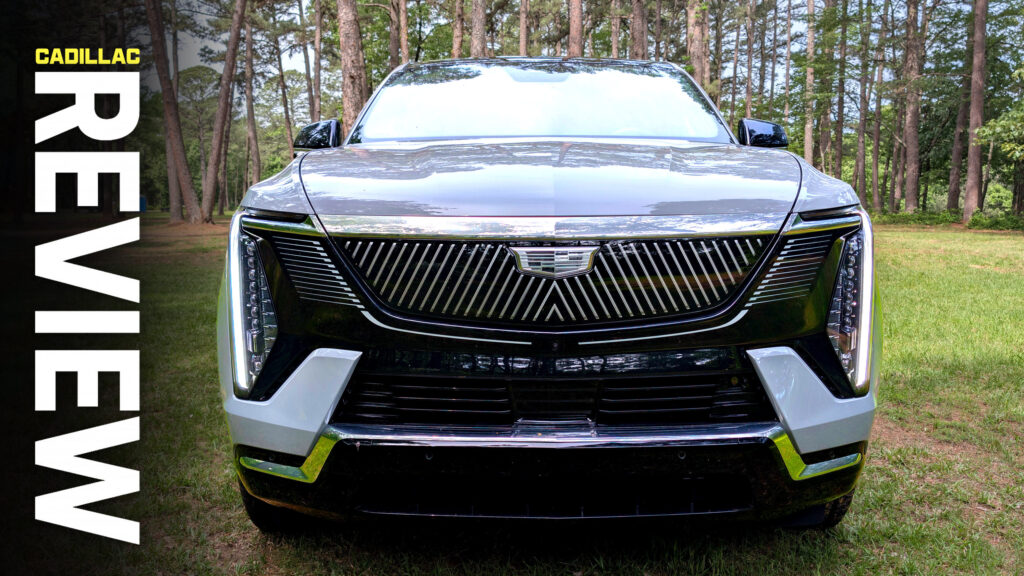
Cadillac got the design right. This thing is massive at 224.3 inches long (5,698 mm), but it doesn’t feel clumsy or awkward. It looks deliberate. Clean. Expensive in a way that doesn’t feel like it’s trying too hard. Even the 24-inch wheels sort of blend into the entire picture while still looking impressive and special.
It still has that Escalade presence. You sit it next to almost anything else, and it just owns the space. But instead of leaning into the old-school boxiness, it smooths things out just enough to feel modern without losing the identity.
More: 2026 Cadillac Vistiq Is The Escalade IQ’s Smaller 3-Row Brother
It honestly feels like a preview of what the gas Escalade should become. And then there are the details. Forget using a common button to open the rear hatch. It opens when you touch the Cadillac crest itself. Amazingly, that’s not the most special ‘opening’ feature either.

The available power doors both open and close with a simple touch. In fact, drivers get to enjoy something usually reserved for super-luxury brands. Slip into the seat, press the brake, and the door will close automatically. Little moments like that matter more than they should. They make the whole experience feel elevated in a way that spec sheets can’t really explain. It’s the kind of thing where you catch yourself thinking, “yeah, this is special.”
Then you start thinking a step ahead.
All of those features? They’re great right now. But what happens when they’re not? What does it cost to fix a power door mechanism on something like this five years from now? What happens when that touch-sensitive hatch stops responding? That question hangs around, at least for a plebeian like me, more than you’d expect. Imagine maintaining the IQ five years from now. Ten? Forget about it.
Drama Stretched Across The Dash

The interior hits you immediately. That 55-inch curved display is one of those features that feels almost unnecessary until you see it in person. It stretches across the entire dash and completely changes how the cabin feels. It’s dramatic, a little over the top, and exactly what this kind of vehicle needs. Pair that with the seating position, and you start to understand the appeal.
The front seats are genuinely excellent. Heated, ventilated, massaging – and not just as a gimmick. They’re actually comfortable over long drives. You sit high, you see everything that’s ahead of you, and there’s this constant sense that you’re in control of something important.
There are also details that show real thought. For example, Cadillac built in two separate wireless charging pads, one for the driver, one for the passenger, placed in a way that feels intentional instead of an afterthought. A cooler quietly sits in the center console and can hold a couple of drinks. Rear screens that actually feel usable, not like an afterthought.
Photos Stephen Rivers / Carscoops
Then there’s the 36-speaker AKG sound system. It’s one of those systems where you start playing songs you’ve already heard a hundred times just to hear them again in this environment. It’s that good. Maybe the Jeep Wagoneer’s McIntosh system is better, but I’d need to hear them back to back to say for sure.
Second-row passengers get treated well, too. Even in standard form, it’s comfortable and spacious and comes with heating and ventilation. Step up to the higher trims, and it turns into something closer to a first-class airline experience, with available massaging seats and tray tables. For a moment, everything lines up. Then you start noticing the details.
Some of the materials don’t quite match the vibe. There’s trim that looks like wood but feels like plastic, and it’s not hidden. It’s the places you touch all the time. Some of the switches, like the center console knob, look high-end but feel like they came from a Power Wheels. It’s not enough to ruin the experience, but it’s enough to interrupt it.

Then there’s the usability. Everything lives in the screen. Climate controls, seat settings, the glove box, most of it. It looks clean, and at first, it feels futuristic. But after a few days, you start wishing for a couple of actual buttons. None of us enjoys swiping to change the temperature. The piano black surfaces don’t help either. They look great for about five minutes. After that, they’re just fingerprints and dust.
The third row is where the illusion fades a bit more. It’s fine. It’s usable. But it doesn’t feel special. It doesn’t match the rest of the cabin. And the fact that passengers back there can’t control their own climate settings feels like an oversight in something this expensive. Cargo functionality also feels unfinished.
Photos Stephen Rivers / Carscoops
The power-folding seats require you to hold buttons the entire time instead of just pressing once and walking away. Sometimes they don’t behave exactly how you expect, and you end up stepping in to fix it manually. None of this is catastrophic. But in a vehicle that’s trying this hard to feel perfect, those things stand out because some vehicles that cost half this much nail it.
Calm Until You Ask It To Corner

The first thing you notice is how calm it feels. At normal speeds, the Escalade IQ does a really good job of isolating you from the outside world. The air suspension and magnetic dampers smooth things out, and on the highway, it’s quiet in a way that feels intentional. This is where it makes the most sense. Long drives are easy. You settle in, turn on Super Cruise, and just let it do its thing. It feels less like driving and more like being carried somewhere. Then you hit a corner, and it might as well be a brick wall because it shifts your thinking just that fast.
This thing weighs over 9,000 pounds (over 4,000 kg), and it never really lets you forget it. There’s body roll. There’s a sense of mass shifting around you. And if you push it even a little, it quickly tells you to back off. It’s not scary. It’s just clear. This is not a vehicle that wants to be driven hard. Even in a straight line, it doesn’t quite deliver what the numbers suggest.
With 750 hp (559 kW), you expect something dramatic. Instead, it feels… fine. It gets up to speed without issue, but it doesn’t pin you back in your seat the way you might expect. A 0–60 time of around five seconds is respectable. It just doesn’t feel like 750 horsepower. And then there’s the ride.
For something this advanced, on wheels this large, it’s good, but not perfect. You still feel some of the road. Cracks and bumps come through more than you might expect. Steering and braking are solid, predictable, and easy to live with. But again, everything is filtered through that weight. I’ll be honest. The Escalade IQ was genuinely engaging to use for a week, but when something that weighed a third as much showed up, I was excited to drive it even though it had a similar trim in terms of power.
Super Cruise And A 460-Mile Cushion

There’s a lot of genuinely impressive tech here. Rear-wheel steering is one of the highlights. It makes this massive SUV feel smaller in tight spaces. U-turns are easier than they should be. Parking is less stressful than you’d expect. That alone makes daily life with this thing better.
Super Cruise is another win. On the highway, it transforms the experience. Long drives become quieter, calmer, and easier. It fits the Escalade’s personality perfectly. Then there’s the range.
At around 460 miles, this is one of the longest-range EVs you can buy right now. And in real-world use, that matters. Plenty have proven that it can go beyond 500 miles without hypermiling. You can go days, sometimes longer, without even thinking about charging. It removes a lot of the mental load that comes with owning an EV.
Read: The Escalade IQ Gets Louder Without Making A Sound
Until you plug it in somewhere public, that is, because charging something this big isn’t cheap. Seeing a triple-digit charging session bill hits differently. It changes how you think about the whole “EVs are cheaper to run” conversation. At this scale, it’s just not that simple. Yes, it charges quickly when you find a fast charger. Yes, the range is excellent.
But there’s no getting around the fact that feeding a battery this size costs real money. Generally speaking, it’s good advice to say that if you can’t charge at home, don’t own an EV. Escalade IQ owners can afford to charge wherever, but charging at home will save them thousands every year.
Competition
Let’s be real. Nothing truly compares apples to apples to the Escalade IQ. No other SUV weighs this much (save for its cousin, the Hummer EV SUV). No electric three-row SUV is this big or has this kind of range. Very few SUVs have the type of luxury features you’ll find here, and that’s across all powertrain types. This SUV is sincerely unique. Want better driving dynamics? Pretty much everything beats this. Want this kind of range, size, and luxury in an EV? You won’t find it.

Final Thoughts
Let’s just be honest about it. The Escalade IQ is heavy. It doesn’t handle particularly well.
It doesn’t feel as fast as the numbers suggest. Some of the materials aren’t quite where they should be. The tech can be more complicated than it needs to be. And charging it in the real world can get expensive quickly.
You feel all of that. You live with all of that. And yet…
You also get one of the most comfortable, quiet, and genuinely impressive luxury experiences on the road right now. You get range that removes most of the stress of EV ownership. You get a cabin that feels like an event every time you step into it. You get presence, real presence, in a way that very few vehicles can deliver.
And more than anything else, you get something that feels like the top of the market. Because right now, this is the most luxurious three-row electric SUV you can buy, full stop. The Escalade IQ isn’t trying to be balanced. It’s trying to make an impression. And it does. You just have to decide if you’re okay with everything that comes along with that.