








It’s been a few years since I got behind the wheel of the first BYD, something called the E6. It was vaguely competent, but immensely rough around the edges. A toe-in-the-water exercise in how an electric car should be, and something that was bettered in most respects by anything from Tesla, or even Nissan’s Leaf.
Looking back at that now infamous interview from 2011, you know, the one where Elon Musk scoffs at the idea of BYD being a serious player in the field, I get it. On the face of it, BYD had no business being mentioned in the same breath as Tesla.
QUICK FACTS
SWIPE
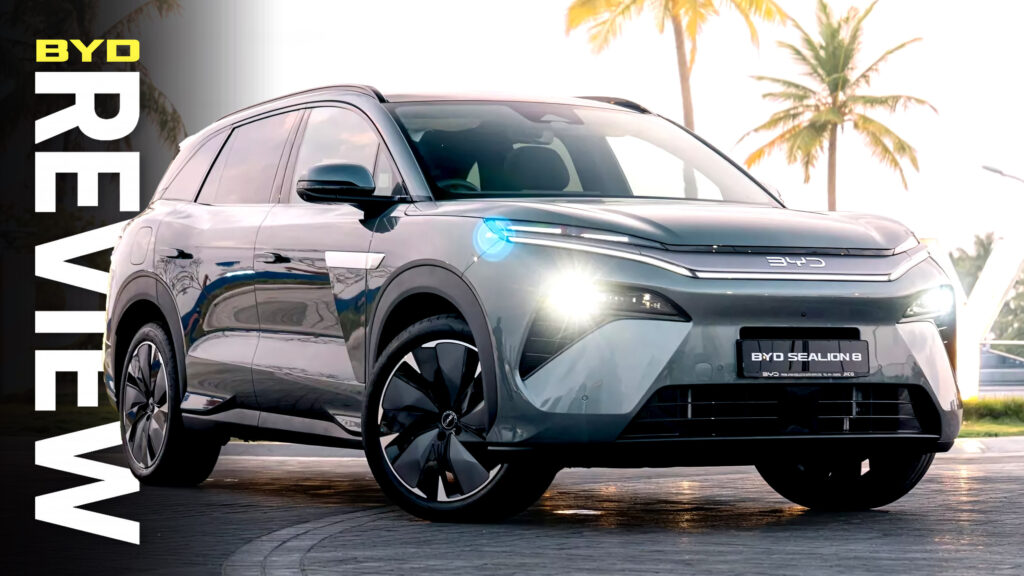
But getting behind the wheel of the all-new Sealion 8, that notion has been blown away. Now, before we get ahead of ourselves, this is by no means a perfect car. It has its faults and quirks, and still exhibits some minor foibles that belie the fact that it’s from a newcomer to the game.
But the Sealion 8 also represents a level of progress that, objectively, cannot be ignored. Even in the last few years, the lineup from BYD (and indeed other Chinese new energy vehicle marques) has improved by leaps and bounds.
Oh No, Another Gushy Chinese EV Review…

Well, in a way, yes. But then this is a car that appears to warrant it. We’ll get to why in a moment, but first, let’s start with figuring out what exactly the Sealion 8 is because it is not, in fact, a Sealion.
Okay, BYD has a serious identity problem for sure. This goes beyond the time when, for instance, Honda had two distinct models called the Accord, depending on where you lived.
Review: The 2026 BYD Sealion 7 Performance Promises Tesla Trouble, But The Details Say Hold On
I’ll try to break it down as quickly and easily as possible, but it’s something I’m definitely going to have to revisit in future articles. In its Chinese home market, BYD has distinct sub-brands: the Ocean series, the Song Series, and the Dynasty series. The so-called Ocean Series incorporates aquatic-inspired designs, and are named appropriately too: think Seal, Dolphin, and Shark.
However, while the Ocean series has managed to swim to greater seas abroad, it seems that the Dynasty nomenclature is set to stay domestic-only. But when it comes to exporting models within the Dynasty and Song lines, we now find them being rebranded under the Ocean Series. So you get the Sealion 6 (called the Song Plus within China), the Sealion 5 (The Song Pro), and this, the Sealion 8, aka the artist formerly known as the Dynasty Tang L.
If you’re not confused enough, in some markets it’s called the Atto 8. I could try to rationalize what constitutes an Atto, but I feel like it’s wholly irrelevant, and at this point BYD is just trying to confuse itself.
You’ve Confused Me Enough; Just Tell Me What It Is
Photos Kulindu Oneth / Carscoops
Gotcha. The Sealion 8 is an upmarketish seven-seater SUV that is available in a range of drivetrain configurations, including plug-in hybrid and EV. The model we’ve got is the “Premium” dual-motor all-wheel drive plug-in hybrid known as the DM-P Premium. There’s also the Dynamic DM-I, which has just the one electric motor driving the front wheels.
The “big” story is that this is a seven-seater, with three rows of seats — likely the first seven-seat BYD offered to many markets. If you’ve been following the news, you’ll know that legacy carmakers, some of whom once dominated Chinese markets, are seeing sales dips like never before. Why? Because Chinese automakers are offering more compelling products.
There’s immense competition back in BYD’s home market. Having been on the ground there and with the opportunity to speak with several consumers, there’s just so much choice in the market. Plus, local brands seem to understand their audiences best.
Although price wars are rampant, self-driving tech is a genuine sales pitch and not a gimmick, and the application of EV and NEV drivetrains is one that local companies are able to grasp much more easily. Yes, there are government-backed subsidies too, which no doubt help. But the reality is that Western manufacturers are truly looked upon as old-tech offerings now.
Now, having a car laden to the gills with the biggest touchscreens and with the fanciest of interiors may work in China, but for export markets, there are still things that consumers look for before jumping into the unknown. The way a car drives, the way it rides, and of course, the way it has been put together. And to be honest, we’ve had some issues with all of the above on some Chinese cars we’ve tested before.
Let’s Start With How It Feels
Photos Kulindu Oneth / Carscoops
The Sealion 8 Premium is definitely trying to feel more upmarket than some of the other SUV options in the range. As such, you get real leather seats, which feature heating, ventilation, and massage functionality for both the front row and the two outboard seats in the second row. There’s a heated steering wheel too, a full-length panoramic moonroof, and a 21-speaker sound system.
The interior, like most modern BYDs, it has to be said, is very well screwed together. It feels premium in here, with contrasting materials across the dashboard, soft-touch surfaces, and a bit of an artsy approach to the way the speaker grilles are mounted, covered with some fabric surfacing.
There’s a 15.6-inch touch screen in the center, which is fixed in landscape, vs some of the swiveling portrait-capable items we’ve seen on other BYD products. The screen is clear, but it’s the only way to control the temperature and fan-speed settings of the HVAC system, which will be a perpetual bugbear until legislation outlaws it.

Ahead of the driver is a much-improved 12.3-inch screen, which is not only very legible in bright sunlight, but now integrates Android Auto/Apple Car Play map functionality right inside it. The only gripe I have is that the text for the battery capacity and fuel levels are just too small to be noted with a quick glance.
Speaking of small things, you’d have to get a magnifying glass, combined with your extra pedantic pants, to spot some flaws in the interior, but they do exist. The odd dodgy stitch, and pieces of on-screen dialogue that haven’t quite been translated down to a T are all I could really find.
Meanwhile, the second row is quite a nice place to be as well. Rear seat passengers have access to climate controls and USB-C ports, and the seats can be slid forward and backward to give the third row extra access.
The third row is, like most SUVs, cramming it in there, more for occasional use only. An interesting decision for the third-row folding mechanism, however, is that BYD has opted to make it the more straightforward manual self-collapsing type, rather than adding a bunch of electric motors to the mix. In most cases, it makes the process quicker and less likely to face any kind of hiccup somewhere down the line. However, it also means that you have to manually ensure the second row of seating is far enough forward before you try to fold the third row away.
So, How Does It Behave Behind The Wheel?

The Premium version we tested of the Sealion 8 gets its DiSus-C tech: the entry-level semi-active suspension tech that sits below DiSus-A (air suspension) and DiSus-P/Disus-X (fully active hydraulic). We say entry level, but in the Sealion 8 it’s a quantum leap forward vs how BYD’s on conventional coils have felt.
In the past, BYD haven’t really been able to get their cars to handle like the Europeans. The Sealion 6 and Atto 3 both have too much bodyroll, and like to bounce excessively. The Sealion 7 went the other way, limiting body roll, but feeling especially harsh when it didn’t need to. The dynamic suspension on the Sealion 8 is probably the closest this Chinese manufacturer has been able to get, and dare I say it, surpass, some other options in the market.
The adaptive dampers react very well to changeable road surfaces. Over very rutted roads the suspension absorbs large undulations, while keeping the body relatively level, with little to no rebound. On faster stretches with high-speed cornering sections, it almost feels hunkered down. It avoids eliminating body roll, but does so to a great degree, so much so that it may just be one of the best handling BYD SUVs yet.
It’s not without its problems, though. The 21-inch wheels on the Premium (20-inch on the Dynamic) do tend to tramline just a bit, and if they were to fall into a pothole, rear seat passengers feel it more than the front. Some extra profile rubber (or smaller wheels) would probably fix that one. And the steering, although precise, is quite devoid of feedback, feeling overly assisted and insufficiently weighted at higher speeds.

Performance is swift, if not as neck-snapping as some other EV and PHEV models we’ve seen. Combined power comes in at 359 kW, with 675 Nm of torque, which has to shift a curb weight of 2,580kg (5,688 lbs). But, behind the wheel of the Premium model, which claims a 0-100km/h (62mph) time of 4.9 seconds with a top speed of 200 km/h (124 mph), you do feel like this mid-size SUV has the pace to get out of its own way. However, it fails to feel overly fast, or performance-oriented, despite what the raw figures may suggest.
In real-world situations, you have a selection of drive mode options that allow you to deploy the PHEV drivetrain to the best of your situation. You can choose to harvest electrical energy as best possible, deploy it as the system feels fit, or run on pure EV for short runs around town. In its default, though, the system feels unobtrusive and allows for a claimed range of 1,117 km (694 miles) from the combination of the engine’s 60-liter (15.9 gallon) fuel tank and the motor’s battery.
So, What’s The Verdict?

The Sealion 8 is another step in the right direction for BYD, and being a plug-in hybrid, this could just be the car that manages to swing the fence-sitters into action. Like any car, it’s not perfect. But compared to previous iterations from the company, the flaws and quirks are becoming fewer and further between.
The Sealion 8 is still being rolled out to markets outside of China, and this particular unit was tested in the heavily and somewhat inconsistently taxed Sri Lanka, where a Premium model will retail for LKR 34,900,000 (US$111,000). In Australia, the same spec is priced at AU$70,990 (US$48,835), which puts it squarely in the sights of the fully-electric seven-seat Tesla Model Y L, which starts at AU$74,900 (US$51,520). It undercuts the Model Y on price, and offers an extra dose of combustion to boot, but having yet to test the latest iteration for ourselves, it’ll be an interesting comparison to make in the future.
Regardless, the Sealion 8 is the best proof yet that we’ve seen that this Chinese company means business. Of course, as with any automotive review, we can only judge on the look, feel, and application of the product in the now. The real test will be that of time. But, with all the evidence in front of us, you’d have to be brave to bet against the Chinese on this one.