










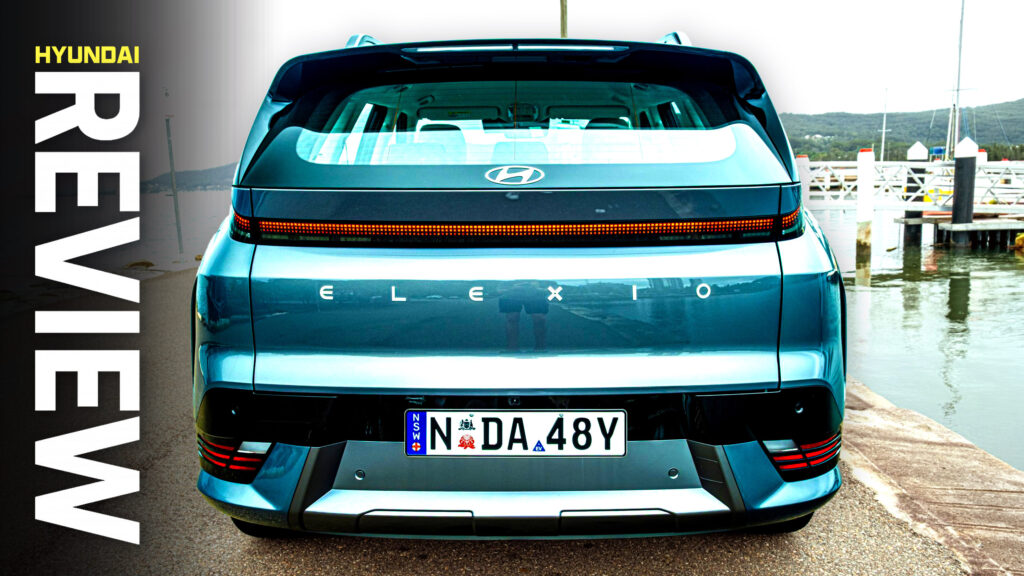
Electric vehicles make up just over 8 percent of new car sales in Australia, so they are hardly dominant. Yet the competitive noise has increased dramatically in recent years, thanks largely to a surge of new Chinese brands. Hyundai’s counterpunch is the Elexio, its latest EV and one aimed squarely at that fast-growing crowd.
The Elexio is unlike any other electric Hyundai so far. Crucially, it was not developed entirely in-house, but rather brought to life through its joint venture partnership with BAIC Motors.
Review: The 2026 Ioniq 9 Calligraphy’s Biggest Threat Is Hyundai Itself
This means it is built in China, tapping into the country’s vast manufacturing scale and efficiency, paired with the engineering experience and brand weight of a legacy player like Hyundai. When it was revealed last year, it looked set to remain a China-only model. Instead, it has now landed in Australia, and we were among the first to get behind the wheel earlier this month.
QUICK FACTS
SWIPE
According to Hyundai, the Elexio has been designed to neatly slot between the Kona EV and Ioniq 5 in its line-up, serving as an all-electric alternative to the Hyundai Tucson. It’s Hyundai’s answer to popular competitors like the Tesla Model Y, Kia EV5, BYD Sealion 7, and Xpeng G6, and this is reflected in the price.
Can It Compete On Price?
Hyundai Australia
Two versions will be offered: the base Elexio and the flagship Elexio Elite. Prices for the base version will start at AU$58,990 (US$41,900) before on-road costs, while the Elite will be priced from AU$61,990 (US$44,000). However, the Elite will be available for AU$59,990 (US$42,600), including all on-road costs, in a limited-time deal running until the end of March.
Hyundai is predicting big things for the Elexio and expects it to be its best-selling EV in Australia. Achieving this won’t be easy. The Kia EV6 undercuts the Elexio at AU$56,770 (US$40,300), the Tesla Model Y Premium is available from AU$58,900 (US$41,800), and the BYD Sealion 7 Premium is available from AU$54,990 (US$39,000). The superb Zeekr 7X also undercuts it at AU$57,900 (US$41,100).
Big Battery, Modest Charging Speeds

So, what do you get for your money in the world of the Elexio? Like Hyundai’s Ioniq models, and unlike the Kia EV5, the Chinese-built Elexio uses the familiar E-GMP platform. However, it doesn’t have an 800-volt architecture like the Ioniqs, instead using a 400-volt system.
With this in mind, charging the battery pack 10-80 percent on a 150 kW charger, with peak speeds in the mid-120s, will take 38 minutes. This is slightly slower than the Kia EV5, which takes 36 minutes, but whereas it has a compact 64.2 kWh battery, the Hyundai has a much larger and more practical 88.1 kWh unit.
This battery powers a front-mounted electric motor with 160 kW (215 hp) and 310 Nm (236 lb-ft). Hyundai quotes a combined efficiency of 18.2 kWh/100 km, which is okay, but certainly not class-leading.
A Digital-First Cabin
Photos Brad Anderson/Carscoops
We only sampled the Elexio in flagship Elite trim, so first impressions came fully loaded. Stepping into the cabin for the first time, it is immediately clear this is not your typical Hyundai interior.
Dominating the interior is a massive widescreen 27-inch display, encompassing both the central infotainment display and a display for the passenger. This screen houses Hyundai’s new Connect-C infotainment system and runs on Android Automotive with a powerful Snapdragon 8295 processor and Unreal 3D graphics engine.
While there are several cars on sale in China with a similar passenger and infotainment screen, this is one of the first implementations of a display like this in a Western market. It looks great, providing excellent colors, clarity, and response. However, it’s not particularly practical to use, especially when you’re driving.
Photos Brad Anderson/Carscoops
I am quite tall with long arms, yet adjusting the climate controls or digging into vehicle settings on the move meant leaning forward and stretching almost to the limit. It should not feel like a light workout just to change the temperature. The more traditional screens in other current Hyundai models are much easier to reach, as are the tablet-like displays found in many of the Elexio’s rivals.
Read: Hyundai’s New EV Costs Over Twice As Much In Australia As In China
On the plus side, the new Connect-C system is good and is far more modern than Hyundai’s outgoing software. It has a much smartphone-like layout with convenient shortcuts on the driver’s side.
In a Hyundai first, a traditional gauge cluster has been replaced by a head-up display. In photos, it doesn’t look like a HUD at all, but rather a physical cluster positioned at the base of the windshield. In reality, it is a true head-up display, albeit it projects onto a small black area of the windshield, providing better contrast than HUDs that project onto normal glass.
The obvious downside of this is that if you chip or crack the windshield, you probably won’t be able to buy a generic HUD-compatible replacement, but rather need one from Hyundai with this black element.
Quality And Space

The rest of the cabin is quite minimal, as many EVs are today. In terms of fit and finish, it feels on par with some Chinese rivals, like the BYD Sealion 7, and is certainly more premium than the Kia EV5. There’s soft-touch suede on the dashboard and door panels, as well as heated and ventilated front seats, and plenty of leather. Dual wireless chargers are also standard on the Elite.
Overall, space and comfort are good, whether that be in the front row or the second-row. While the Elexio only has a wheelbase of 2,750 mm (108.2 inches), 5 mm (0.1 inches) less than the Tucson and 250 mm (9.8 inches) less than the Ioniq 5, there’s still plenty of legroom for rear passengers, and that includes adults. Cargo space is decent, rated at 506 liters (17.8 cubic-feet) or 1,540 liters (54.3 cubic-feet) with the rear seats folded 60/40 flat.
How Does It Drive?
Photos Brad Anderson/Carscoops
Driving the Elexio revealed that it is a solid performer, and it does some things well. However, it fails to stand out from the competition and could benefit from some tweaks to lift it to a new level.
As any EV should, the Elexio’s powertrain is smooth and quiet, providing more than enough grunt for everyday driving duties, whether that be in urban settings or on the highway.
Review: Why Kia’s New EV5 SUV Makes More Sense Than A Model Y
With 160 kW (215 hp) and 310 Nm (236 lb-ft), the Elexio has exactly the same power as the front-wheel drive Kia EV5. Crucially, it doesn’t suffer from the same horrible torque steer that the EV5 does. In fact, there’s no torque steer whatsoever, which is a great thing. However, like the EV5, the Elexio does love to spin up its inside front wheel should you get greedy with the throttle and play around with the traction control.

Efficiency is not so good. After several stints behind the wheel of the Elexio, we averaged 19.5 kWh/100 km, which is quite poor, particularly given that we averaged 20.5 kWh/100 km in the Sealion 7 Performance, and it has an extra 230 kW (308 hp) and 380 Nm (280 lb-ft) of torque.
Like other Hyundai and Kia EVs, the Elexio has paddle shifters behind the steering wheel to adjust the level of brake regeneration, which is something every EV should have. I spent most of my time in the one pedal i-Pedal mode, with it bringing the SUV to a smooth and predictable stop every time. The transition between the mechanical brakes and the regen is also imperceptible, so kudos to Hyundai for that.
The brand says that, like most of the cars it sells in Australia, the Elexio has been specifically tuned for local roads by teams of engineers from South Korea. I was pleasantly surprised with the Elexio’s ride, finding it to be comfortable and softer than many other EVs, which can be too firm and harsh over bumps.
Software Still Finding Its Feet
Photos Brad Anderson/Carscoops
In addition to tweaking the suspension for Australia, Hyundai insinuated during a press briefing that the Elexio’s advanced driver assistance system have also been set up for local conditions. Despite this, further refinements are needed.
During long highway jaunts, there were several instances when the lane-keeping assist and lane-centering functions failed to recognize clearly-marked lines, causing it to slowly drift into adjacent lanes. In addition, I experienced some slow ping-ponging between lane markings. This is odd as the dozens of other Hyundai and Kia models I’ve tested in recent years all have great lane-keeping systems, keeping you locked in the center of the lane on well-marked highways.
Review: 2026 Zeekr 7X Performance Is Proof That Tesla Isn’t The Benchmark Anymore
In addition, there was an instance where I had the adaptive cruise control enabled on a 100 km/h (62 mph) country road when suddenly, the Elexio suddenly braked to 75 km/h (47 mph) despite there being no object or car in front of me. I suspect the large semi-truck traveling in the opposite direction in the lane next to me fooled the system.
Like so many other new cars built in China, the Hyundai Elexio’s driver monitoring system is overactive, ringing the moment you yawn or take your eyes off the road. Additionally, turning it offer requires multiple steps through the menu, which is frustrating.
Verdict
Photos Brad Anderson/Carscoops
The Hyundai Elexio is definitely better than the Kia EV5, which has quickly gained popularity in Australia and is the best-selling EV from a legacy brand in the local market. With this in mind, there’s a good chance that the Elexio should also sell well for Hyundai, and it’ll likely attract many shoppers who were previously interested in the Kona EV or Ioniq 5.
However, it may be prudent for buyers to exercise some patience before getting an Elexio. Earlier this year, Hyundai slashed prices of the Inster by AU$7,288 ($5,200), and reduced the Kona Electric by more than AU$13,000 ($9,200). If internal sales targets are missed, similar price adjustments for the Elexio would hardly be surprising.
Just as importantly, Hyundai’s latest EV still needs a few software refinements, particularly to its ADAS, before it feels like the clear choice in an increasingly crowded segment.