










- The 2026 Jeep Grand Cherokee offers a Level 2 hands-free driving system.
- It operates on more than 200,000 miles of compatible roads in North America.
- The system works remarkably well, but feels overly cautious sometimes.
When you think about semi-autonomous driving systems, what comes to mind? Most likely Tesla’s Full-Self Driving, GM’s Super Cruise, or Ford’s Blue Cruise.
While those are the best-known systems on the market, they’re far from the only options. Stellantis launched their Hands–Free Active Driving Assist system a few years ago, but it’s largely flown under the radar.
Review: I Tried Out GM’s Smarter Super Cruise And It Feels Promising
Part of this can be chalked up to the fact that Hands–Free Active Driving Assist is only available on a handful of models including the Grand Cherokee and Ram 1500. That’s a shame because, after hundreds of miles traveling hands-free, it’s clear the system works remarkably well.
Like other Level 2 semi-autonomous driving systems, Hands–Free Active Driving Assist uses a series of cameras, sensors, and radar to monitor lane markings and your surroundings. It also has a driver monitoring camera mounted on top of the steering wheel, which ensures you’re paying attention when the vehicle is driving itself.
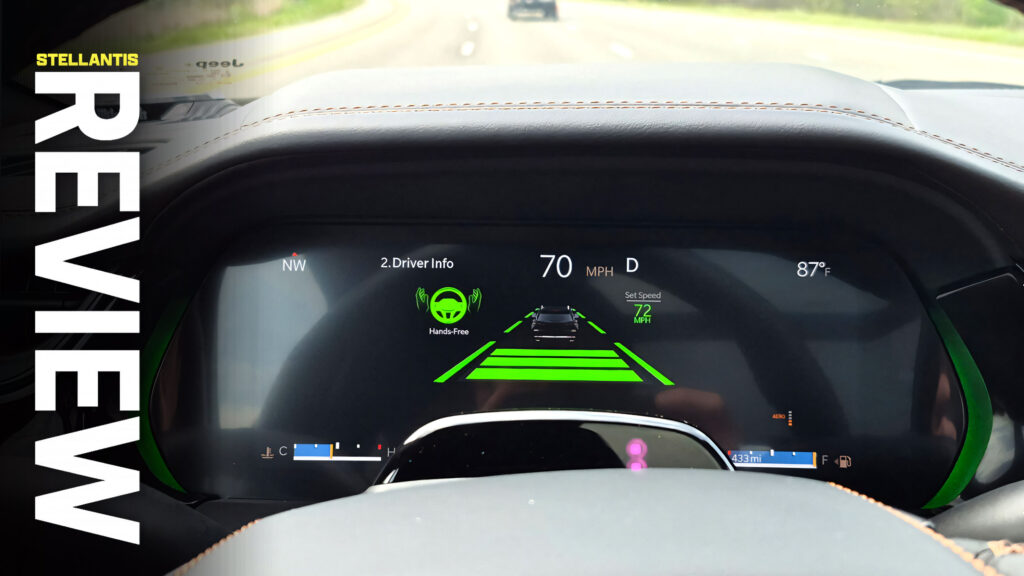
Hands–Free Active Driving Assist works on over 200,000 miles (321,869 km) of roads in North America and using it is pretty straight forward. When driving on the highway, you tap a button on the steering wheel to activate the system, and then set your speed. If you’re on a compatible road, the instrument cluster surround will turn green as will an icon.

In the 2026 Grand Cherokee, there are a couple of cluster display options, including one that shows detailed driver assistance information. This was my preferred setup as the display made it clear when the vehicle was operating hands-free. It also shows your selected following distance and other important information.
During our testing, Hands–Free Active Driving Assist worked well as it kept the Grand Cherokee centered in its lane and didn’t have any problem dealing with subtle curves. Speaking of which, the system anticipates curves and can automatically slow down for them.
Hands–Free Active Driving Assist steers in a smooth and steady fashion, which makes long drives far more relaxing. To ensure people don’t get distracted, the driver monitoring system only allows you to advert your gaze from the road ahead for approximately ten seconds at a time. After that point, the cluster display will change from green to orange and the seat will vibrate to get your attention. If that gentle reminder doesn’t prompt a response, the screen will eventually turn red, a warning will sound, and the seat will vibrate more intensely.

The driver monitoring system could easily see through my sunglasses and it didn’t come across as naggy or annoying. It mainly serves as a gentle reminder to pay attention to the task at hand.
When you come across a slower moving vehicle, the system will automatically slow down and keep its distance. If you want to pass, a tap of the turn signal will engage an Assisted Lane Change. This works well for the most part, as the vehicle will check its surroundings and ensure the lane is open. If it is, and it’s safe to perform the lane change, the system will gently slide the vehicle into an adjacent lane.
While lane changes are performed flawlessly, the system seems overly cautious, especially when other vehicles are around. On multiple occasions, the Grand Cherokee wouldn’t change lanes despite having plenty of room to safely do so. Instead, it stayed in its lane with the blinker on.
That’s a tad annoying, but you can easily override the system and manually change lanes by lightly turning the steering wheel. Once the lane change is complete, hands-free driving automatically resumes.
During our drive, I came across small sections of road where hands-free driving wasn’t available. This wasn’t a big deal as the vehicle gives you a heads up, while keeping lane centering and adaptive cruise control on. All you really need to do is lightly grab the steering wheel and wait to enter another hands-free compatible area.
Overall, Hands–Free Active Driving Assist works well and inspires a lot of confidence. While the system wasn’t shaken by the occasional driver that cut me off, I did feel the need to intervene a few times when a much slower moving vehicle suddenly changed into my lane. The Jeep was approaching them too quickly for my liking, so I manually applied the brakes. The system may have been able to handle these scenarios, but it’s better to be safe than sorry.

There’s a lot to like about Hands–Free Active Driving Assist, but it’s not cheap. The system costs $2,995 on the Grand Cherokee and comes with a three-year subscription. On top of those costs, the technology is limited to higher-end trims.
That’s unfortunate, but Stellantis is embracing a hands-free future. The company recently announced an all-new Level 2++ system that will arrive in 2028 and deliver “hands-free door-to-door supervised automated driving across highway and urban environments.”