










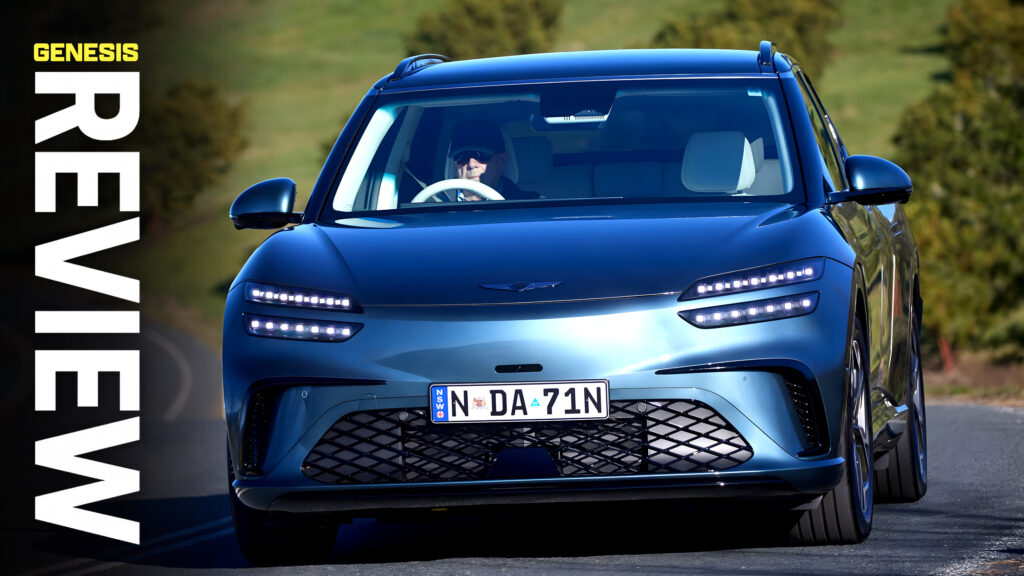
The GV60 has always been a bit of an enigma. It shares its mechanical components with the Hyundai Ioniq 5 and Kia EV6, but the Genesis badge buys a more serious run at luxury and a higher price to go with it. Buyers have responded accordingly, which is to say the GV60 has never come close to matching the sales figures of its corporate siblings.
For the 2027MY, the automaker is looking to better differentiate the GV60 from the cars it shares a platform with. The range has undergone a shake-up in Australia, including the introduction of a new rear-wheel-drive model and the removal of the former all-wheel-drive performance version. Filling the void left behind by this model is the all-new GV60 Magma, serving as a compatriot to the Ioniq 5 N.
Read: 2027 Genesis GV60 Magma Wants To Make BMW And AMG Sweat
As the GV60 has navigated an ever-competitive market in an effort to find its niche, so too has the Genesis brand. Not satisfied with simply focusing on luxury models, it’s now going all-in on performance, creating the Magma brand, entering endurance racing, and now, toying with the idea of establishing its own GT3 racing team.
To see if the GV60 has finally found its niche in the market, we spent some time with the new rear-drive model in Canberra.
QUICK FACTS
SWIPE
Genesis Australia
Looking at photos of the updated GV60, you could be excused for thinking it’s exactly the same as the one that’s been on sale for the past few years. Evidently, Genesis wasn’t interested in overhauling its design, sticking to its recent formula of minor visual and technological upgrades.
Among the key changes made are reshaped front and rear bumpers, tweaked headlights, and new 19-inch wheels. Also new is the price.
When the GV60 first launched in Australia, exclusively in all-wheel-drive configurations, it started at AU$103,700 (US$72,500). In 2022, this was okay, as the market wasn’t as hot as it is now. With more affordable Chinese EVs now hitting the market, Genesis has been forced to cut prices, ditch the standard all-wheel-drive model, and launch the Advanced

Like recent updates made to the Ioniq 5 and EV6, it features a new 84 kWh battery pack and a new electric motor with 168 kW (225 hp) and 350 Nm (258 lb-ft). The price has also fallen to AU$88,300 ($61,800). Then there’s the new flagship GV60 Magma, priced from AU$130,000 (US$91,200) that we’ll be testing soon.
This version has been a long time coming. It follows a familiar recipe to the Ioniq 5 N and Ioniq 6 N, rocking twin electric motors that combine to deliver 448 kW (601 hp) and 700 Nm (516 lb-ft) of torque. It’s the first model launched by Magma and is a sign of things to come with other performance cars to come. Crucially, Magma should not be considered in the same vein as Hyundai N, as it has a different philosophy: it’s eager to retain the luxury and refinement it’s known for while adding some extra thrills. You’ll be able to hear our thoughts on the GV60 Magma next week.
This Is No Hyundai Interior
Genesis Australia
Cabin changes to the GV60 Advanced, like those made on the outside, are relatively minimal. A key addition is Hyundai’s excellent 27-inch infotainment and gauge cluster and an updated steering wheel.
As ever, the GV60 continues to give occupants a classy feel that makes it a joy to spend time driving.
Wireless Apple CarPlay and Android Auto are both standard across all GV60 models, and both work well. Compared to some all-new EVs from Asia, the GV60’s displays are relatively simple and lack some of the quirky features, games, and funky graphics. On the plus side, this means the software is exceedingly easy to navigate, without any overly complex menus.

As with all current Genesis models, the cabin of the GV60 feels premium and well thought out. Unlike so many other EVs out there, they are not overly reliant on screens, retaining a separate climate control screen and buttons. Among all EVs on the market, few do as good a job as the GV60 in perfectly combining tactile controls with screens. This includes the car’s famous spinning Crystal Sphere gear selector, which has been retained.
Review: 2023 Genesis GV60 Performance AWD Will Silence The Naysayers
A welcome update is the fitment of standard wing mirrors. The pre-facelift GV60 had been available with cameras, instead of mirrors, and while they worked well enough, they did leave a little to be desired. No doubt the cost of replacing them, were they to ever get damaged, would have been astronomical, too.
Other welcome features found within the Genesis include leather-appointed, 12-way adjustable driver and front passenger seats, heated and ventilated front seats, and dual-zone climate control. There’s also all the standard safety equipment you’d expect, including forward collision-avoidance assist, lane keeping assist and lane following assist, as well as parking aids and a 3D, surround-view monitor.
All That An EV Should Be

For everyday driving, the GV60 Advanced is a smooth and all-round quiet performer, which is just what existing Genesis owners would expect and is demanded by buyers coming from other luxury brands.
As with the pre-facelift model, the updated GV60 feels much like an Ioniq 5, although behind the wheel, it does feel slightly smaller and nimbler, owing to the 100 mm (3.9-inch) shorter wheelbase. Of course, it’s also noticeably more luxurious than the Hyundai, or the Kia EV6, and I think this alone is enough to justify the higher price tag.
Beyond this new model receiving a larger battery pack, it also includes improved pre-heating and cooling functions to boost charging speeds. Genesis doesn’t quote a peak DC charging speed for the standard GV60, instead noting that it supports DC fast charger stations rated at up to 350 kW.

Other E-GMP-based EVs from the Hyundai Motor Group typically cap out at around 220 kW or 230 kW. The driving range has been boosted to 561 km (348 miles) on the WLTP cycle, and a charge from 10-80 percent can take as little as 18 minutes through an appropriately fast charger. The GV60 also supports a vehicle-to-load (V2L) function, capable of delivering up to 3.6 kW of power, enough to run power tools and household appliances.
Chassis changes have also been made. This includes the fitment of a new low-friction U-joint to reduce steering friction and updated rear hydraulic bushings, minimizing vibrations and noise transmitted through the chassis. The GV60 Advanced beautifully soaks up imperfections in the road, although admittedly, most of the roads we drove on during the launch were silky smooth.
Thick, acoustic glass adds to the sense of isolation while behind the wheel of the GV60. It really is a serene experience, although much the same can be said about loads of other EVs on the market. This is ultimately one of the core appeals of electric powertrains, and is something that is nigh-on impossible to replicate in a combustion car.
Genesis Australia
Acceleration is solid, although certainly not neck-snapping quite like the old, all-wheel drive Performance model. Genesis doesn’t quite have a 0-100 km/h (0-62 mph) time, but it feels somewhere around the mid-7-second mark.
Updates have also been made to the regenerative braking. Like the older model, this new one includes four different levels of brake regen, including a one-pedal driving mode, all configurable using the steering wheel-mounted paddle shifters. A new feature is the full auto mode, which intelligently tweaks the level of regeneration depending on what the car thinks is appropriate, using traffic flow and navigation information and even taking into consideration upcoming intersections and roundabouts. For the most part, it works well.
Genesis quotes a combined efficiency of 16.7 kWh/100 km over the combined cycle. We ended up averaging 18.5 kWh/100 km, although this was over a relatively short loop of mountainous roads, so improvements can be expected in more ordinary and urban driving environments.
Verdict

There’s a lot to like about the 2027 GV60. It is an exceptionally polished and well-rounded EV and feels special enough to command a price premium over the related Hyundai Ioniq 5 and Kia EV6. For those looking for a practical, comfortable, and stylish EV, it is an excellent option.
Ultimately, it will not be a huge volume seller like some of the larger and cheaper EVs that have started to flood the Australian market. When compared to other premium alternatives from legacy brands, like Lexus with its RZ priced from AU$84,500 (US$59,300), and the BMW iX1 available from AU$79,900 (US$56,100), the GV60 stacks up quite nicely. It’s an excellent choice for the discerning buyer, but perhaps not for the masses.