










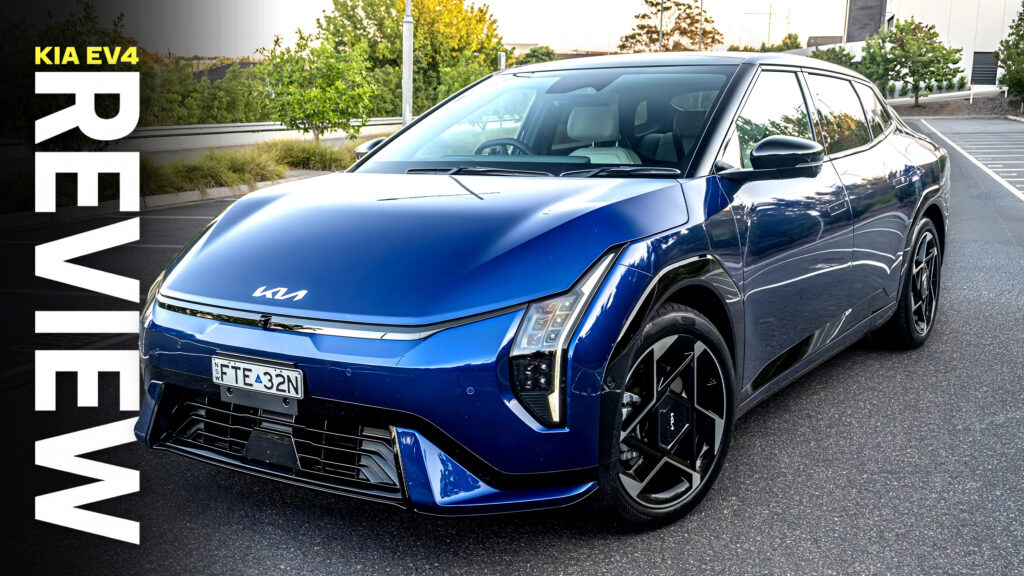
A year ago, electric sedans looked like a settled bet. Not anymore. As recently as October last year, Kia was planning to build and sell the all-electric EV4 in the United States, aimed directly at the ever-popular Tesla Model 3.
However, the American market for EVs is markedly different now than it was in early 2025, due in no small part to the Trump administration’s pro-ICE policies and abandonment of the federal EV tax credit. This has forced Kia to indefinitely postpone the EV4 in America. While the US won’t get it, at least not yet, the EV4 has landed in several markets, including Australia.
Read: Kia Finally Brings An Affordable EV To America, Fake Gears And All
To see if the States are missing out on an exceptional electric sedan, or if it is perhaps better off without it, we recently lived with one for a week. Sadly for our American readers, they don’t get to experience a very competitive EV.
QUICK FACTS
SWIPE
Photos Brad Anderson/Carscoops
While much of the EV4 is similar to other current Kia EVs, much of it is also unique. For starters, it’s been developed in both sedan and Hatch guises, and in some markets, is sold in both configurations. Australia only gets the sedan, which is the version that the US was also going to receive.
Underpinning the EV4 is the familiar Electric Group Modular Platform (E-GMP) from Hyundai, but in this application, it’s a 400-volt system rather than the 800-volt architecture of models like the Hyundai Ioniq 5, Kia EV6, and others.
The downside of this platform is slower charging speeds. According to Kia, the max DC charge rate is a disappointing 128 kW. On the flip side, this cheaper platform has allowed Kia to make the EV4 more affordable. It starts at AU$49,990 ($35,800) for the EV4 Air Standard Range, and goes up to AU$59,190 ($42,400) for the EV4 Earth Long Range, and AU$64,690 ($46,300) for the EV4 GT-Line Long Range that we tested.

To put these prices into perspective, the Tesla Model 3 starts at AU$54,900 ($39,300) and tops out at AU$80,900 ($58,000), while the BYD Seal is available from as little as AU$46,990 ($33,700), has a mid-range AU$52,990 ($38,000) version, and tops out at AU$61,990 ($44,400).
What do you get for your money? The Standard Range model utilizes a 58.3 kWh battery pack and a front-mounted electric motor with 150 kW (201 hp) and 283 Nm (209 lb-ft) of torque. Long Range versions have the same motor, but are fitted with an 81.4 kWh pack, boosting the claimed driving range from 456 km (283 miles) to 612 km (380 miles).
As we’ve seen from many other Kia EVs in recent years, the EV4 doesn’t want to blend in. It looks more like a concept car than one you can actually walk into a showroom and buy, with the sedan being even more striking than the hatch.
Likely eager to maximize cargo space, Kia has extended the roofline and stretched the rear window, so it almost looks like a cross between a sedan and an estate. Or, more aptly, it looks a bit like the hunchback of Notre Dame, because pretty, it is not.
Well-Equipped And Tech-Forward
Photos Brad Anderson/Carscoops
The cabin of Kia’s latest electric sedan is similar to that of some of the brand’s other EVs, but it has unique elements that make it stand out.
Key features include a pair of 12.3-inch screens and a smaller 5.0-inch display sandwiched between them, used for climate control. As in the much larger EV9, this central screen is mostly blocked by the steering wheel, but there are also physical HVAC toggles positioned further down on the dashboard.
With wireless Apple CarPlay and Android Auto, the infotainment display feels modern enough, even if the software is a little simple to what’s found in some of the EV4’s rivals.
Photos Brad Anderson/Carscoops
The surfaces feel slightly more premium than those of the EV5, and there are nice metallic switches for the seat heater and ventilation functions near the door handles. There’s also an abundance of storage between the seats, as well as a wireless smartphone charger.
In addition, the Earth and GT-Line models get a pair of premium front seats with pillowy headrests that feel great. These seats also include a one-touch reclining mode. It’s also nice that the seats can be adjusted very low, ensuring that even taller drivers have heaps of headroom.
Review: 2023 Hyundai Ioniq 6 Epiq Shakes Up The EV Hierarchy
The downsides of the EV4 sedan’s shape can be mostly felt in the second row. If you’re over 6 feet, there’s a good chance your hair will brush on the headliner. In addition, toe room is almost non-existent if one of the front seats is adjusted into a low position. While there are a couple of air vents in the rear, there unfortunately aren’t any temperature or fan speed controls.
Cargo volume is good, with Kia quoting 490 liters (17.3 cubic feet) of space in the trunk. Crucially, both rear seats can be folded flat, creating a large pass-through area that greatly enhances the car’s practicality.
Drives Like A Premium Sedan
Photos Brad Anderson/Carscoops
Given the specifications of the EV4, one can’t expect it to feel like a performance car, even in flagship GT-Line guise. However, it feels just as poised and polished to drive as the competition, as well as some more expensive electric offerings from Hyundai’s own stable, including the Ioniq 6.
The highlight of driving the EV4 isn’t the powertrain, its efficiency, or noise isolation, but rather how exceptional the ride quality is.
Like all other Kia models sold in Australia, the EV4 has undergone comprehensive local testing to fine-tune its ride, ensuring it perfectly irons out bumps and imperfections on the country’s often poorly surfaced roads.

It’s not an adjustable system, meaning there’s no way to stiffen or relax the ride as in some more expensive sedans. But it doesn’t need any adjustments, as it’s just about perfect and one of the most comfortable cars I’ve driven in quite some time.
Potholes and speed bumps are often a nuisance, but in the EV4, they completely fade into insignificance. It’s really quite extraordinary how well it rides, and it’s almost at the same standard as the Audi e-tron GT, which can cost over five times as much and has one of the more complex air suspension systems on the market. The Earth and GT-Line models have 19-inch wheels, while the Air sits on smaller 17-inch shoes, and may even be more supple.
The EV4’s sophisticated feel extends beyond its ride quality. Given that it’s down just 10 kW (13 hp) and 27 Nm (20 lb-ft) of torque from the EV5 SUV, I had expected the EV4 to suffer from the same torque steer qualms as its bigger brother. However, there’s not even a hint of torque steer under full throttle, perhaps in part due to the suspension setup.
Photos Brad Anderson/Carscoops
In addition, the EV4 doesn’t have quite the same propensity to spin up its inside front wheel as we found in the EV5. Admittedly, it’s not particularly quick and needs about 8 seconds to reach 100 km/h (62 mph). That said, it never feels like it’s lacking power.
It’s a shame that the GT-Line doesn’t have a dual-motor, all-wheel drive setup as found in some of Kia’s other GT-Line-badged EVs, particularly since the cheaper BYD Seal Performance has twin motors and an impressive 390 kW (523 hp) and 670 Nm (494 lb-ft) of torque.
Kia presented a GT version of the EV4 earlier this year, complete with twin motors producing 215 kW (282 hp), but I’d have liked to see this powertrain offered in the GT-Line, given the price point. This would have allowed Kia to develop a full-blown performance version to rival the BYD and the Tesla Model 3 Performance.

One good thing about the EV4’s single-motor setup is efficiency. Over my week with the car, I averaged just 14.3 kWh/100 km, beating Kia’s claimed 14.9 kWh/100 km and giving it a very achievable range of around 550 km (342 miles). It’s worth noting, however, that I spent most of my time with the EV4 driving in Eco mode and the regenerative braking in one-pedal mode.
The EV4’s steering has been well-calibrated and offers varying levels of feel depending on the driving mode. It’s also hard to fault how the EV4 feels under braking, with a consistent, smooth pedal feel and no noticeable shift from regenerative braking to mechanical braking.
While the EV4 does not prioritize performance, it handles shockingly well, thanks in part to the Goodyear tires. Front-end bite is great, and there’s plenty of grip.
Verdict

While the Kia EV4 looks a little odd, that doesn’t detract from the fact that it delivers exactly what an electric sedan like this should, at this price point.
It’s exceptionally efficient and undercuts many of its nearest rivals on price, all with the assurance of buying from a well-established brand with an expansive dealership and service network. The EV4’s ride is the standout, the cabin is well-equipped, and it offers plenty of range. If it were based on an 800-volt architecture that supported faster charging speeds, it would be difficult to fault. It’s a shame it won’t be sold in the US.