










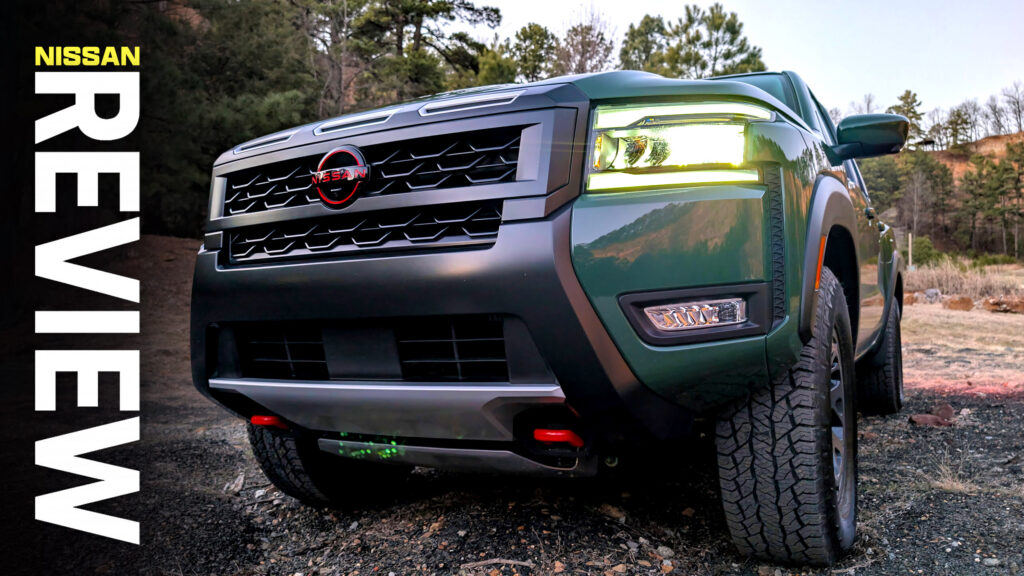
The Nissan Frontier is a legendary model playing in a space with heavy hitters. Last year, we drove the extensively redesigned 2025 version and found that it was an old-school truck. One that both benefited and sometimes missed the mark because of that more basic countenance.
Now, we’ve just had a crack at the 2026 Pro-4X with some updated features, a lot more off-road time, and our original experience in mind.
What’s immediately apparent is that Nissan hasn’t tried to reinvent the Frontier. It still skips the turbocharged four-cylinder engines, hybrid systems, and complicated interfaces that are quickly becoming the norm in this segment. Instead, Nissan doubled down on what made the truck interesting in the first place.
And after spending days throwing the Pro-4X down muddy trails, sandy climbs, and deeply rutted paths where one wheel was regularly hanging in mid-air, we think we understand this truck better than before. The Frontier isn’t just old-school. It’s intentionally uncomplicated.
Quick Facts
SWIPE
Styling

From a visual standpoint, the Frontier is largely unchanged from when we drove it a year ago. One notable new feature is Nissan’s new Dark Armor package. It comes with 17-inch black alloy wheels, darkened mirror caps, front grille, and exterior badging. While our Pro-4X didn’t have this full package, the two share the same wheels, and our test truck featured dark mirror caps and a dark grille.
The entire pickup is very clearly a Nissan from every angle. The Pro-4X trim adds a little presence, and small touches like the Lava Red tow hooks help it stand out as special in the Frontier lineup. The proportions are straightforward, and the graphics on the bed aren’t as flashy as those of a Ford Raptor or Toyota TRD PRO. Overall, it’s understated, which fits well with the rest of this truck’s vibe.
Interior

The same philosophy carries over to the cabin. Modern trucks increasingly resemble luxury SUVs inside, and while that sounds appealing, it often means more touch-sensitive controls, more complicated menus, and more things to break. The Frontier Pro-4X remains refreshingly straightforward.
The climate controls are physical buttons and knobs. The steering wheel uses real switches rather than touch-sensitive panels. Even the infotainment system, which can be equipped with a 12.3-inch display, includes actual buttons for audio and navigation shortcuts.
For 2026, Nissan makes the Pro-4X easier to live with by adding more standard features, including heated front seats, a heated steering wheel, remote start, and an eight-way power-adjustable driver’s seat.
Review: Sometimes, Old-School Recipes Work Just Fine
The seats themselves are wide and comfortable, particularly in the front row. There’s plenty of headroom, and visibility is excellent. Nissan’s chunky dashboard design feels rugged without being cheap, and the overall fit and finish are better than you might expect given the truck’s relatively modest price. The only drawback here is that because this design is so similar to the last generation, it can feel cheap and half-baked to some.
That said, there are thoughtful touches throughout. The center console includes dedicated holders for pens and markers. Storage beneath the rear seats is useful. The bed still offers Nissan’s excellent Utili-Track system, a spray-in bedliner, and an available 120-volt outlet.
What the Frontier doesn’t offer is much rear-seat space. Adults in the back will quickly run out of legroom, especially compared to a Ranger or Tacoma. The cabin also doesn’t feel as airy or modern as some rivals. Then again, that’s sort of the point, but we’ll stop short of saying that it’s better because in reality, each user will have their own preferences here.
The Frontier isn’t trying to impress you with a 14-inch touchscreen or an ambient-lighting package with 37 colors. It’s trying to give you the controls you need, where you need them, in a way that still makes sense five or ten years from now. There’s a charm to that attitude.
A Tried And True Drivetrain

Under the hood, nothing changes for 2026, and that’s perfectly fine. Nissan continues to fit the Frontier with its 3.8-liter direct-injected V6, an engine that feels increasingly rare in a world where nearly every competitor has downsized to a turbocharged four-cylinder.
The V6 makes 310 hp (231 kW) and 281 lb-ft (380 Nm), all of which goes through a nine-speed automatic transmission. Nissan’s gearbox might not shift with the urgency of the best modern automatics, but it’s smooth, predictable, and generally stays out of the way. Fuel economy figures for the Frontier are 19 mpg in the city, 24 on the highway, and 21 combined. We achieved just 19.3 mpg, but we were off-road quite a lot.
More importantly, the whole powertrain feels durable. There’s no turbocharger to worry about years down the road. No hybrid battery pack. No complicated multi-mode air suspension. For buyers who keep trucks for a decade or more, that matters.
The Frontier Pro-4X also gets the hardware that matters most once the pavement ends. Bilstein off-road shocks, all-terrain tires, skid plates, an electronic locking rear differential, and, for 2026, a much more useful drive mode selector. We’ll come back to that shortly, though.
Driving Impressions

Don’t be too shocked when we tell you that the Frontier still drives like an older truck on the road. As we pointed out a year ago, the steering is heavy because Nissan doesn’t give this truck electric assist of any sort. On top of that, the brake and throttle pedals require a little more effort than they do in a Ranger or Colorado. The ride is stiff when the bed is empty and the turning radius remains frustratingly large.
In town, that means the Frontier can feel more cumbersome than some of its competitors. Parking lots require more steering input than they should, and narrow U-turns can quickly become three-point turns.
But once the pavement ends, the same traits that feel dated on the road start to make more sense.
More: Nissan Keeps On Trucking With An Upgraded Frontier
The heavy steering offers excellent feedback. The throttle is easy to modulate with precision. And because there’s less electronic filtering between you and the truck, the Frontier feels more predictable over rough terrain.
During our testing, we drove the Pro-4X over multiple trails that repeatedly lifted one wheel entirely off the ground. In many trucks, that’s where you start hearing frantic traction-control systems grabbing brakes, cutting power, and making a lot of noise. The Frontier just kept moving.

Remember those drive modes? Unlike some rivals that bury these settings in touchscreen menus or comically silly 17-way knob/switch/dial contraption, Nissan places everything right where you’d expect. Twist the transfer case knob for 2WD, 4Hi, or 4Lo. Then use one of the clearly labeled buttons beneath the shifter: On-Road, Sand, Mud, Rock, or Hill Descent Control. That’s it.

There’s no hunting through a giant screen, wondering if Baja mode works better than Off-Road Plus or if one traction-control setting automatically disables another. The Frontier tells you exactly what each mode does and lets you get on with driving.
There’s even a dedicated rear differential lock button to the left of the steering wheel, sitting beside several blank spaces ready for aftermarket auxiliary switches. It almost feels like Nissan expects owners to modify these trucks themselves instead of leasing them for three years and trading them in.

It’s not perfect, though. With 9.5 inches (241 mm) of ground clearance, the Frontier is good off-road but not exceptional. Trucks like the Toyota Tacoma Trailhunter, Chevrolet Colorado ZR2, and Ford Ranger Raptor offer more clearance, better suspension travel, and more capability in serious rock-crawling scenarios.
The Nissan also lacks the sheer wheel travel and underbody clearance needed for truly hardcore terrain. We never tackled any extreme rock crawling during our time with it, and frankly, the Frontier isn’t really built for that. If your weekends revolve around Moab or technical boulder fields, there are better choices.

But for the kind of trails most owners will actually drive, forest roads, muddy ruts, washed-out paths, and steep dirt climbs, the Frontier is more than capable.
And unlike many of its competitors, it accomplishes that without making the driver feel like they need a training course just to understand how the truck works.
Competition

The Frontier Pro-4X occupies an increasingly unusual place in the midsize truck segment. The Toyota Tacoma is more advanced and offers hybrid power, but it’s also more expensive and more complicated. The Chevrolet Colorado and GMC Canyon feel more modern and tow more, while the Ford Ranger provides better power and more rear-seat space.
Then there are trucks like the Jeep Gladiator and Toyota Tacoma Trailhunter, which can go farther off-road but at a dramatically higher price. The Nissan’s biggest strength is that it avoids trying to do too much. The reality here is that none of these options is objectively bad. They all have something going for them.

At around $45,000 fully loaded, the Frontier Pro-4X remains relatively affordable. More importantly, it still feels like a truck designed by people who understand that not every buyer wants a rolling command center to deal with on every drive.
For those who do want something more extreme, Nissan now points them toward the new Frontier PRO-4X R by Roush. That truck adds a two-inch lift, Ohlins suspension, upgraded control arms, 265/70R17 Hankook Dynapro AT2 Xtreme tires, and more aggressive styling.
Frankly, it sounds like the version of the Frontier for buyers who looked at the standard truck and immediately started planning modifications. It should be far better in difficult terrain thanks to its added clearance and upgraded suspension. But it also somewhat misses the charm of the regular Pro-4X, which is appealing precisely because it feels simple, attainable, and easy to live with.
Final Thoughts

The 2026 Nissan Frontier Pro-4X isn’t the most advanced truck in the midsize segment. It doesn’t have the trickiest suspension, the most screens, the cleverest powertrain, or the biggest list of software-driven off-road features. And that’s exactly why it works.
There’s an interesting trend happening in the sports car world right now. As mainstream performance cars become faster and more computerized, a growing number of boutique automakers are moving in the opposite direction. They’re building lighter, simpler machines that put more responsibility in the driver’s hands.
Those cars succeed because they make the driver feel like they’re the reason the car is doing something impressive. Not because they selected Track Mode Plus, disabled one stability-control setting, left another one active, and let the software do the hard work.
Nissan, whether by design or a simple lack of funding to go super tech-heavy, is channeling that same philosophy off-road with the Frontier Pro-4X. It doesn’t have endless terrain submenus, complex suspension tricks, or a half-dozen overlapping traction programs. Instead, it gives the driver a strong chassis, a locking rear differential, useful tires, and a few clearly labeled controls.
This is one of the few midsize pickups that feels like it could realistically be maintained by a determined owner with a toolbox and a free weekend. Combine that with its solid, well-rounded engineering, and it’s easy to see why some people prefer a truck that feels like a trusted tool and less like a smartphone on all-terrain tires.