










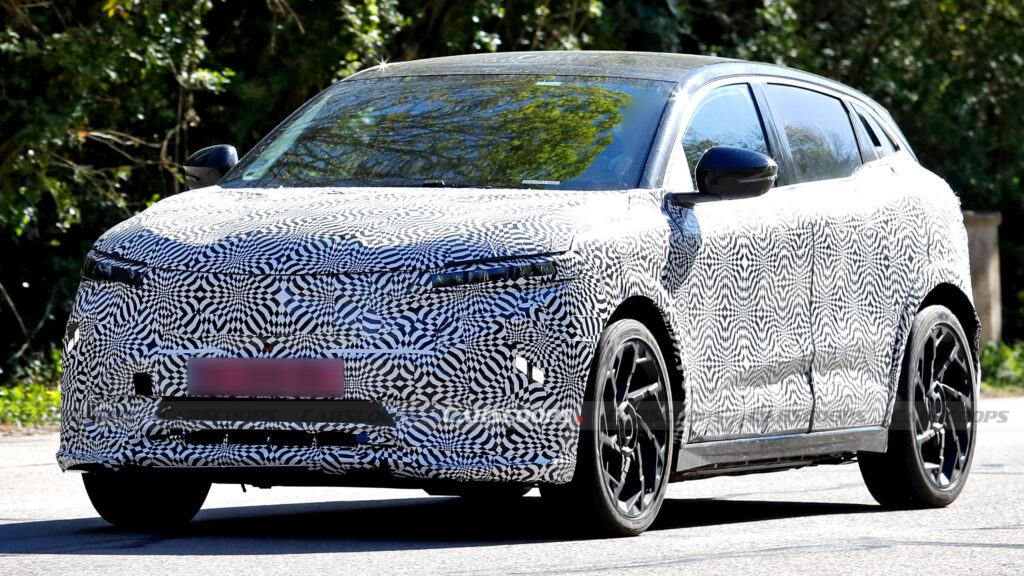
- Renault has been caught testing a facelifted Megane E-Tech due next year.
- New LED headlights and revised taillights are visible on the prototype.
- The current model’s 60 kWh battery pack lags behind Renault’s own Scenic.
It’s been four years since Renault made the controversial decision to launch an electric SUV with the Megane nameplate. While the Megane E-Tech has failed to trouble the market’s most popular electric SUVs, Renault isn’t willing to throw in the towel just yet and is readying an update for it.
Pictured here for the first time is a facelifted version of the Megane E-Tech, expected to hit the market next year. Since the launch of the current model, Renault has introduced several other new SUVs, including the Symbioz and Scenic E-Tech, and tweaks to the Megane could make it look a little more like those models.
Read: Renault’s Compact EV Will Get A Refresh Following Its Nissan Cousin
This heavily camouflaged prototype retains the same overall shape as the existing model, and we can clearly see some changes have been made to the headlights. While the shape of the main headlamps looks familiar, the LED daytime running lights are clearly different, even though we can only see small parts of them.
Updates have also been made to the rear of the Megane E-Tech with new LED taillights visible and what appears to be a tweaked bumper.
New Batteries?
Baldauf
It’s unclear what changes will be made under the skin of the updated Megane E-Tech. Currently, the SUV is offered with 40 kWh and 60 kWh battery packs, both of which are quite small for a vehicle of this size. By comparison, the admittedly-bigger Scenic E-Tech offers a much larger 87 kWh pack, which is more in line with what we’d expect from an SUV like the Megane.
Like the Scenic, the Megane E-Tech is based on the company’s AmpR Medium architecture, also used by vehicles like the Nissan Ariya and Nissan Leaf, which offer 90 kWh and 75 kWh battery packs, respectively.
Given the shared platform, Renault might have the scope to increase the size of the Megane’s battery pack. Recent reports have suggested it could source new batteries from AESC and produced in France. This should help to boost the EV’s driving range, which currently tops out at 454 km (282 miles).