










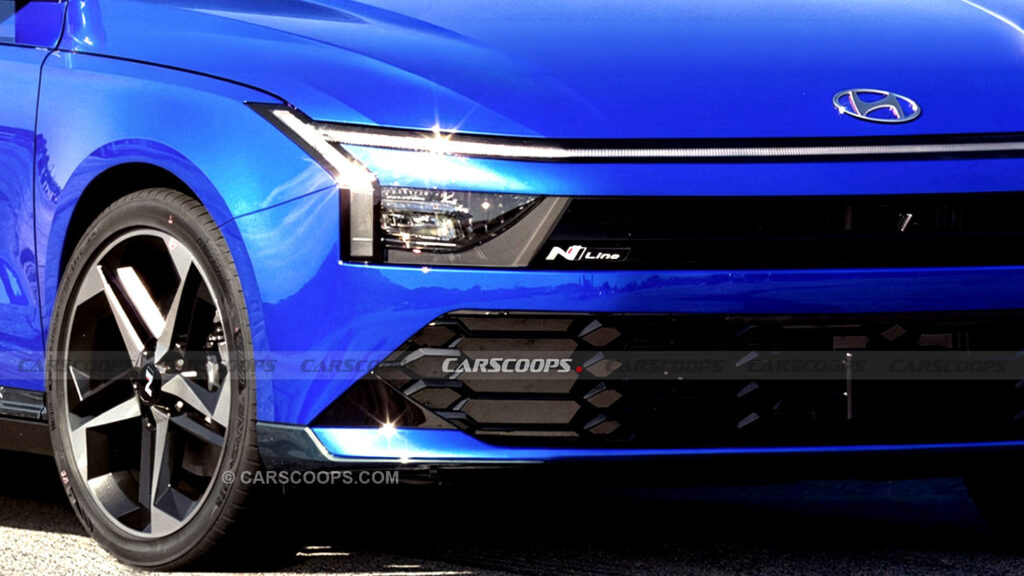
- New styling brings cleaner lines and light-bar themes.
- Android-based PLEOS Connect replaces twin screens.
- Engine options mirror Kia K4 with hybrid available.
Hyundai’s Elantra might not be the biggest hitter in its class, yet it does well for the Seoul-based automaker on a global scale. In many markets, it remains one of Hyundai’s most recognizable badges, holding its ground against long-established rivals. In the States, it was the company’s third best-seller behind the Tucson and Santa Fe, shifting more than 148,000 units, up nearly 9 percent year over year.
The wedgy, seventh-generation compact sedan has been with us for a few years now, and an all-new redesign is just around the corner.
Also: More Than 50 New Cars Are Coming In 2026
Code-named CN8, the eighth-generation Elantra will be a vast departure from previous iterations, with a larger footprint, new styling, and interior hardware. Hyundai appears to be repositioning the model slightly more upmarket, giving it a stronger visual identity and a more spacious cabin to match evolving buyer expectations. Keen to learn more? Read on as we take an illustrated preview of what to expect.
Dynamic Looks

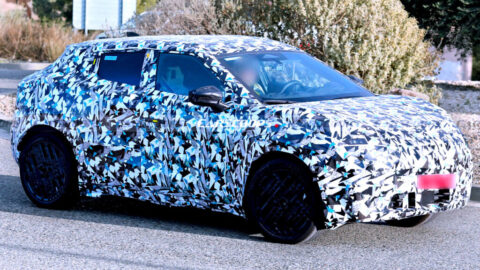
The outgoing car was all about diagonal lines and sharp edges, yet the next-generation Elantra offers a much more mature aesthetic, garnished with futuristic details.
Future Cars: Hyundai’s New Tucson Looks Nothing Like The One It’s Replacing
At the front, onlookers are greeted by a horizontal light bar that boomerangs down the flanks. Further down, the main LED headlamp clusters are joined by a slimline grille, with a larger trapezoidal intake below.
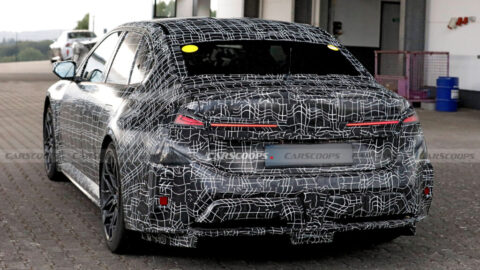
Profile-wise, things take an alternative turn with an upright glasshouse defined by quirky rear-quarter glass placement; it almost appears free-floating within the body-coloured rear pillars. Out back, it has a thin horizontal taillight strip across the trunk, flanked by additional vertical elements at the corners.
Screen Time

Big changes are underway inside, where Hyundai Motor Group’s in-house-developed infotainment system, dubbed ‘PLEOS Connect,’ is set to make its debut. It replaces the previous twin-screen layout with a large central display paired with a slim digital instrument cluster.
This new setup runs Android Automotive OS, allowing app downloads, over-the-air updates, and access to Gleo AI, Hyundai’s built-in conversational assistant.

Elsewhere, it’s a mini-Palisade look with a high-cowl dash, minimalist door cards, and lots of ovoid detailing. Fortunately, there’s a row of physical buttons below the main touchscreen for key functions, with ventilation controls below that. That decision should be welcomed by drivers who still prefer tactile shortcuts for everyday adjustments.
Core cabin dimensions will grow, with increased legroom in the front and rear, and improved shoulder room. The leaked figures back that up. Overall length will reportedly grow to 187.6 inches (4,765 mm), an extra 2.2 inches (55 mm), while width expands to 73.0 inches (1,855 mm), up 1.4 inches (35 mm). The wheelbase now measures 108.3 inches (2,750 mm), a further 1.2-inch (30 mm) stretch between the axles.
Powertrains

Under the hood, expect a familiar playbook. The Elantra’s engine range should closely shadow the Kia K4, starting with a 140 hp hybrid built around a 1.6-litre petrol engine. From there, it likely steps up to a 147 hp (110 kW) 2.0-litre four-cylinder, plus a 200 hp turbocharged 1.6-litre for those who prefer their compact with a bit more urgency. Certain markets may also get an LPG variant.
Future Cars: Ford Killed Fiesta For A Crossover, Now It Might Return Like This
All versions are tipped to remain front-wheel drive, paired exclusively with an 8-speed dual-clutch automatic transmission.
As for the high-performance Elantra N, it’s on the way, likely packing over 300 hp from a 2.5-litre turbocharged four-cylinder. The downside? A manual gearbox is expected to sit this one out, which may sting for the purists.
A prototype of the new Hyundai Elantra undergoing testing. (Photos Baldauf)
Rivals And Reveal
Key rivals remain the usual suspects: Toyota Corolla, Mazda 3, Honda Civic, Nissan Sentra, and the closely related Kia K4. An official reveal should land in the coming months, with sales penciled in for early 2027. That timing means North America could see it arrive as either a 2027MY or 2028MY, depending on how the calendar shakes out.
Future Cars: New Toyota Corolla Is Done Playing The Boring Sedan Game
With larger dimensions, upgraded tech, and a sharper design, the new Elantra seems determined to take the fight to these competitors on more than just price, leaning on space and a more grown-up feel.
What do you think of the Elantra’s polarising new look? We’d love to hear your views in the comments below.