










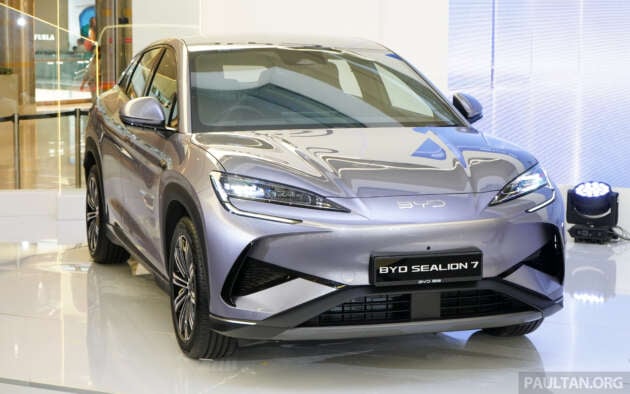
Following the teaser for it earlier this week, BYD Malaysia has introduced the updated 2026 BYD Sealion 7, with the refresh officially making its debut earlier this morning. “Redefined further for tomorrow,” as the company puts it, the changes to the all-electric crossover are not comprehensive, but contain some technical changes.
More importantly, the Sealion 7 range has been expanded from when it was launched here in 2024, with the Premium (RWD) and Performance (AWD) being joined by a new baseline Dynamic variant, which the company says opens up the model to a wider audience range. The three Sealion 7 models are priced at:
- Sealion 7 Dynamic (RWD) – RM163,800
- Sealion 7 Premium (RWD) – RM188,800
- Sealion 7 Performance (AWD) – RM203,800
While the Dynamic opens up a new lower price point for the car, the Premium and Performance are costlier than when they were launched back in November 2024, when the Premium (RWD) went for RM183,800 and the Performance (AWD), for RM199,800.

In terms of technical specifications, the entry-level Dynamic features a single rear motor offering 245 PS (241 hp, or 170 kW) and 380 Nm, which allows it to do the 0-100 km/h sprint in 7.3 seconds. It gets a 71.8 kWh Blade lithium iron phosphate (LFP) battery, which provides a range of 520 km (NEDC), translating to about 440 km on a WLTP-cycle. The car supports DC charging of up to 110 kW.
As for the Premium and Performance, the output numbers on both variants continue unchanged from before, with the single rear motor Premium delivering 313 PS (308 hp, or 230 kW) and 380 Nm of torque, offering a 0-100 km/h sprint time of of 6.9 seconds (which interestingly is 0.2 seconds higher than the 6.7 seconds quoted for the earlier iteration).
Meanwhile, the all-wheel drive Performance retains the prior configuration of a 218 PS (215 hp, or 160 kW) and 310 Nm front motor being added on top of the same rear motor on the Premium to offer a total system output of 523 hp (530 PS, or 390 kW) and 690 Nm. Its zero to 100 km/h sprint time remains at 4.5 seconds.
What has changed for both is the battery capacity and the operating range of the car. Both Premium and Performance now get the 91.3 kWh Blade LFP battery (previously 82.5 kWh), which was available for the car when it was introduced in Europe.

On the Premium, the unit offers travel of up to 650 km (NEDC) on a single charge, which is about 553 km on a WLTP-cycle. As for the AWD model, it enables a range of up to 502 km on the WLTP cycle, which is quite a bit higher than the 454 km offered by the pre-update Performance with the 82.5 kWh pack
Perhaps more importantly, the bigger battery brings with it an 800-volt electrical architecture, which follows on the introduction for it on the Atto 3 here earlier this year. This now enables DC fast charging for the duo at up to 230 kW, up from the 150 kW previously. As a result, charge times are now lower, the car being able to be topped up from 10 to 80% in just 24 minutes compared to 32 minutes on the 400-volt models previously.
Not many changes otherwise, with the car retaining the exterior styling cues seen previously, save for a new colour called Ultraviolet, available for the Premium.
Inside, the cabin presentation remains unchanged, with the same 10.25-inch digital instrument cluster and 15.6-inch central portrait/landscape switchable touchscreen display combination to be found, along with familiar items such as an illuminated passenger panel, four-spoke steering and a 50-inch augmented reality head-up display.

The kit list is also essentially unchanged on the higher end variants – you get dual-zone air-conditioning, a 50 watt wireless mobile charger, wireless Apple CarPlay and Android Auto connectivity and four USB ports (two front, two rear, one Type-A and one Type-C each).
Both the Premium and Performance continue to be equipped with a 12-speaker Dynaudio sound system, but the Dynamic makes do with a 10-speaker in-house premium audio system. Elsewhere, the Premium and Performance gain a hands-free kick activated tailgate.
In terms of cargo space, the Sealion 7 comes with a 58 litre frunk, and the Dynamic offers a 500 litre rear trunk, expandable to 1,769 litres with the rear seats folded down. Both the Premium and Performance increase the available space by 20 litres (520 litres, and 1,789 litres with rear seats folded).
Safety and driver assistance kit includes nine airbags (front, front and rear side, side curtain and driver far side), front/rear parking sensors, a 360-degree camera as well as a ADAS suite that includes adaptive cruise control, AEB, lane departure warning and prevention, lane keeping assist, front/rear cross-traffic alert and high beam assist.
The post 2026 BYD Sealion 7 EV launched in Malaysia – 91.3 kWh battery, new base Dynamic variant, fr. RM163,800 appeared first on Paul Tan’s Automotive News.