










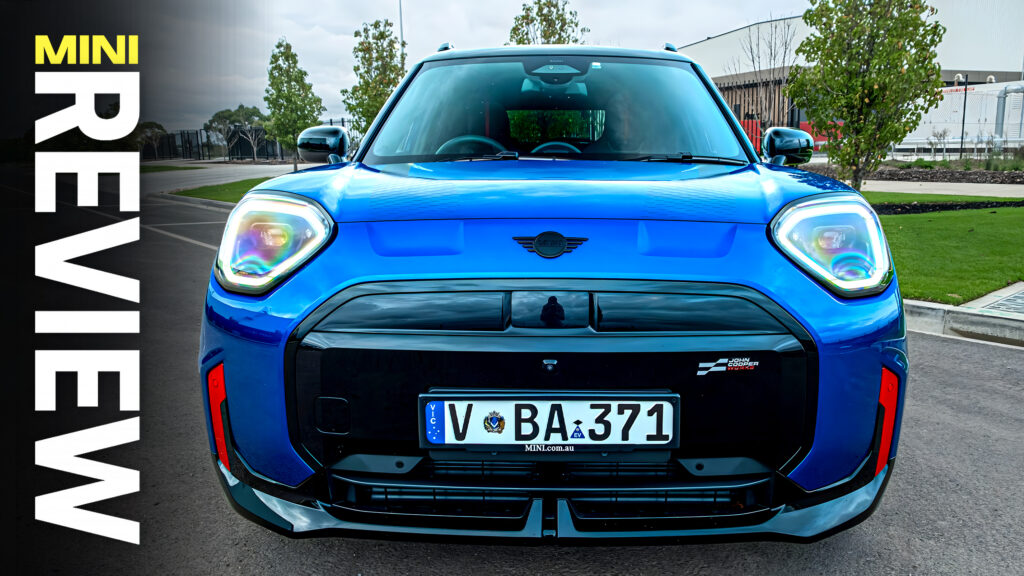
The launch of the Mini Aceman came as a bit of a surprise a couple of years ago, as most probably thought the British brand already had enough models in its line-up.
However, unlike the smaller Cooper and the larger Countryman, both of which come in combustion and all-electric forms, the Aceman is available only as an EV. It’s perhaps one of the most stylish options in this niche of the market, serving as a competitor to models like the Volvo EX30, Skoda Elroq, and Kia EV3.
Read: New Mini Aceman EV Is Big On Space, Small In Size
We recently spent a week living with the Mini Aceman to work out what it’s actually about. And we didn’t grab just any version off the shelf, but the flagship Aceman JCW e Favoured, the one meant to show what the range can do when nobody’s holding back.
QUICK FACTS
SWIPE
*Manufacturer
Photos Brad Anderson/Carscoops
The market for electric hot hatches is quite small, but it is slowly growing. In terms of outright performance, the Aceman could be easily dismissed compared to other electric hatches, including Mini’s smaller two-door Cooper JCW. However, this isn’t to say the Aceman isn’t interesting.
Powering the four-door is a 49 kWh battery pack driving a single electric motor with 190 kW (255 hp) and 350 Nm (258 lb-ft) of torque. This is quite a bit less than the electric Countryman SE ALL4 in JCW trim, rated at 230 kW (308 hp) and 494 Nm (364 lb-ft) of torque. But, unlike that model, the Aceman is front-wheel drive and feels far more frenetic out on the open road. More on that later.
In Australia, the Aceman JCW e Favoured that we drove is available from AU$65,990 ($46,400), excluding on-road costs. That’s more than some of the competition, but Mini models have often come at a premium over less stylish rivals, so that price tag certainly isn’t excessive.
Sporty, But Small
Photos Brad Anderson/Carscoops
The interior of the Aceman could perhaps be best described as joyful, just like other current Mini models.
In terms of practicalities, the Aceman lacks some of the practicalities found with other EVs. It retains a transmission tunnel, albeit a smaller one than combustion models, with only enough roof for a phone, two cupholders, and a small storage cubby. Similarly, the door pockets are small. However, the Mini more than makes up for this with personality.
The dashboard of our tester was clad in black recycled-knit polyester, with a sporty red pattern on the passenger side. It also had red contrast stitching, a red strap serving as the bottom spoke on the steering wheel, and had loads of gold-colored accents, including the speaker grilles and door handles.
Photos Brad Anderson/Carscoops
Sitting in the center is Mini’s now familiar circular infotainment display with wireless Apple CarPlay and Android Auto. Like other Mini models, it has a rather old-school head-up display that shines onto a clear panel which pops up from the dashboard. While it looks a little dated, a big perk is that it remains visible while wearing polarized sunglasses.
As the model we tested was the John Cooper Works version, it also included a Harmon Kardon audio system, a panoramic glass sunroof, and electric seats with a massage function for the driver. It also had one of the best ambient lighting systems I’ve experienced, displaying different patterns on the dash and door panels, and even had checkered patterns running alongside both sides of the glass roof.
The second row is large enough for children, but a no-go for taller adults with limited legroom and even less headroom. With the rear seats up, there’s up to 300 liters (10.5 cubic feet) of cargo space, or 1,005 liters (35.4 cubic feet) with the seats folded down.
Quick, But Compromised

My first impressions while behind the wheel were great. In fact, after stepping into the Aceman e JCW after a week in the more powerful Countryman SE ALL4, I was left scratching my head as to whether I’d read the spec sheet wrong, and it was actually the Aceman with more power.
Read: Mini Unleashed Two Ridiculous JCWs That Break All The Right Rules
The power delivery of the Aceman is noticeably sharper than in the larger electric Countryman. Whereas the all-wheel-drive configuration of the Countryman, and most other dual-motor EVs, delivers smooth, uninterrupted power and traction, the Aceman feels instantly more engaging as it frantically tries to direct power exclusively to the front wheels.
The downside of this setup is torque steer. Under full throttle, the steering wheel aggressively pulls to the left and then to the right, much like some of the industry’s leading hot hatches a decade ago. It can be fun, but it can be alarming, especially if the steer tugs to one side even while trying to accelerate gradually. Things are amped up considerably when you press the Boost button on the steering wheel, instantly unlocking an extra 20 kW (27 hp) for 10-second periods.
Photos Brad Anderson/Carscoops
Similarly, the Aceman struggles to put its power to the ground, particularly in wet conditions, repeatedly triggering traction control as it builds speed.
We found the Aceman e JCW to be slightly slower than Mini claims. The automaker says it can run from 0-100 km/h (62 mph) in 6.4 seconds, but the best time we achieved was 6.5 seconds, with two other runs at 6.7 seconds. Rolling acceleration is reasonable, clocking in at 5.6 seconds from 60-120 km/h (37-75 mph).
Fun In The Corners, Punishing Everywhere Else

For as thrilling as the Aceman can be to drive, the overall driving experience is tarnished by the ride. It’s not uncommon for EVs to ride quite firmly, as they have to carry heavy battery packs under their floors. However, this Mini has a ride so harsh that it makes my decade-old Renault Megane RS, a car noted for having a firm ride back in its day, feel rather plush by comparison.
Over undulating roads, you feel every single bump in the Aceman. On particularly rough roads, I’d glance over to see my partner’s head bouncing around like she was a bobblehead. While there’s no denying the Aceman feels connected to the road, there’s really no good reason for the ride to be this firm. It might work on an ultra-smooth racetrack, but it doesn’t suit driving on the road, let alone daily commuting in a sprawling city riddled with potholes.
On the flip side, the electric Aceman is plenty of fun to toss around corners. While it weighs in at a fairly heavy 1,745 kg (3,847 lbs), it feels significantly lighter, and the ultra-direct steering makes it easy to place on the road, allowing you to perfect that apex. However, regardless of what driving mode you’re in, and even if the traction control is switched off, it’ll still intervene mid-corner, desperately trying to keep those front wheels under control.
While the Aceman eJCW is fun to drive, it is not as engaging as the combustion-engined hot hatches and sporty SUVs priced at this level.
Drive Gently And The Range Delivers
Photos Brad Anderson/Carscoops
The limited driving range is also an issue. A 49-kWh battery pack is roughly on par with some others in this class, like the EX30 with its base 51 kWh pack, and the smaller Alpine A290 with its flagship 52 kWh pack, but those models don’t offer the same level of power. Mini quotes a driving range of just 355 km (221 miles), but that drops significantly if you start driving the car as it’s designed to be driven.
However, unlike some other EVs, it should actually be possible to achieve the quoted driving range. If you drive more sedately, the Aceman will happily average 14 kWh/100 km with the brake regen set to its most aggressive setting.
Verdict

We applaud Mini for developing a sporty, JCW version of the Aceman, as it’s a genuinely entertaining vehicle to drive. It feels quicker than it is, hides its weight well, and has direct, engaging steering.
Unfortunately, it’s let down by a ride that makes it feel jittery and on edge on anything but the smoothest of pavement. If Mini were able to give it a more comfortable ride and rein in some of that torque steer, it could be a very compelling option. For now, interested buyers would probably be best opting for one of the cheaper, less sporty versions.