









The 2026 Jeep Wrangler Moab 392 shouldn’t exist. It costs nearly $90,000. It returns fuel economy figures that would make some full-size pickups seem reasonable. It rides worse than countless SUVs costing far less, and if we’re being honest, most Wrangler buyers would probably be happier in a cheaper model. Jeep even gave the V8 Wrangler a sendoff not long ago with the so-called Final Edition, seemingly signaling that the era of eight-cylinder Wranglers was coming to an end.
And yet here it is. Not only is the V8 Wrangler still alive, but Jeep continues finding buyers willing to spend serious money on one. Which raises an interesting question. Specifically, if a Rubicon X makes more sense, a Bronco Raptor is arguably a better all-around vehicle, and nearly every luxury SUV at this price point is more comfortable, why does the Wrangler Moab 392 continue to exist?
After a week behind the wheel, I think I found the answer.
Quick Facts
SWIPE
Styling: Aggressive, Familiar, And Somehow Still Playful
Photos Stephen Rivers / Carscoops
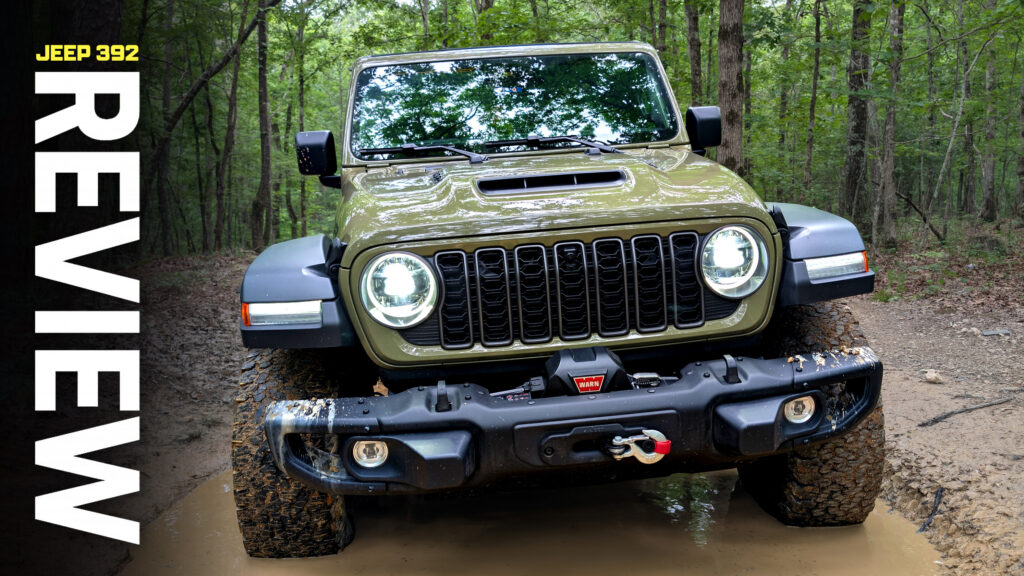
The Moab package doesn’t radically reinvent the Wrangler formula, but that’s probably for the best. Frankly, a lot of modern off-roaders are starting to look like they escaped from a toy store. Giant fender flares, bizarre graphics packages, and styling treatments that seem designed exclusively for Instagram can quickly become exhausting. The Moab mostly avoids that trap. Pretty much every design detail has a function. Even the hood bulge exists to help the engine get clean air even when traversing water or deep mud.
To my eye, it looks great.
More: Ford’s Answer To The Jeep Wrangler 392 Appears To Be Surrender
The stance is aggressive. The proportions remain unmistakably Wrangler. The chunky tires, exposed hinges, upright windshield, and removable roof all communicate exactly what this vehicle is about. Yet despite the tough-guy image, there’s still something playful about it.
Maybe “whimsical” isn’t a word hardcore Jeep enthusiasts want associated with their favorite off-roader, but I can’t think of a better description. There’s a sense of fun baked into every Wrangler. It doesn’t take itself too seriously. You can remove the doors. You can fold back the roof. You can drive it through a mud hole and then park it outside a coffee shop.
The olive-green paint simply named “41” on my tester only enhanced that character. It looked rugged without trying too hard. Tough without appearing cartoonish. Most importantly, it looked like a Wrangler.
Interior: Rugged Doesn’t Mean Cheap

Step inside and you’re immediately reminded that Jeep understands something many automakers have forgotten. Not every function needs to live inside a touchscreen. The Wrangler’s switchgear remains one of its greatest strengths. The buttons are large. The controls are intuitive. Everything feels designed to be operated while wearing gloves, covered in mud, or bouncing around on a trail. And the best part? They just work.
The dedicated controls for the locking differentials, sway-bar disconnect, and various off-road systems are exactly where they should be. There’s no digging through menus or hunting for hidden settings. The switches themselves feel robust, too. They should, considering they’re designed to survive exposure to dirt, dust, mud, water, and the abuse that comes with actual off-road use.
The front seats are also better than many people probably expect. Calling them luxurious might sound strange in the context of a Wrangler, but that’s honestly how they feel relative to the rest of the lineup. They’re supportive, comfortable, and perfectly suitable for long days behind the wheel.
Photos Stephen Rivers / Carscoops
The rear seats aren’t quite as impressive. They’re perfectly usable, but passengers back there get fewer creature comforts. The seatbelts can also ride a bit high depending on occupant size. Still, nobody buys a Wrangler because they’re searching for the ultimate luxury experience. What makes the cabin appealing is its purposefulness.
You’ll find auxiliary switches ready for aftermarket accessories. There are mounting locations for cameras and trail gear. Small Easter eggs appear throughout the cabin. Everything feels like it was designed by people who actually spend time outdoors. Technology is another pleasant surprise.
Uconnect remains one of the better infotainment systems in the business. It’s quick, intuitive, and largely free of the frustrating lag that plagues some competitors. Apple CarPlay and Android Auto connected seamlessly throughout my week with the vehicle.
The camera systems deserve special praise. They’re genuinely useful off-road, particularly when cresting steep obstacles where visibility disappears entirely. The off-road pages are cool too, though I suspect some buyers will never fully explore everything they offer. Personally, I’d still rather use the physical controls whenever possible.
Driving Experience: Equal Parts Thrilling And Terrifying

Let’s address the elephant under the hood. The 6.4-liter naturally aspirated V8 produces 470 hp (350 kW) and 470 lb-ft (637 Nm). It sends that power through an eight-speed automatic transmission and a full-time four-wheel-drive system. The result? A Wrangler that can hit 60 mph in roughly 4.5 seconds. That’s absurd. Absolutely, completely absurd. And it’s not just a marketing figure on a page… if you follow us on Instagram, you’ll have seen that test when it happened and was verified via GPS on a real road, not a drag strip.
It never stops being funny either. You can line up next to sports sedans, family crossovers, and plenty of supposedly quick vehicles, then watch their drivers struggle to process what’s happening as a brick-shaped SUV on 35-inch tires rockets away from a stoplight (To only lawful speeds of course).
The V8 isn’t simply about acceleration, though. In fact, acceleration may be the least interesting thing about it. It’s the sound. The throttle response. The way the engine reacts instantly to your right foot. The little burbles and growls that accompany even routine errands. Every drive feels like an occasion. That said, it’s important not to get overly ambitious.
The Wrangler Moab 392 is quick in a straight line. It is not a sports car. It’s not even up to snuff with most mainstream sport utility vehicles. Throw it into a corner and reality arrives immediately. The body rolls. The tires flex. The suspension moves around.
The whole vehicle starts reminding you exactly what it was designed to do. It’s genuinely unsettling if you forget what you’re driving. Try that in rain, like we did on day one with it, and you’ll find yourself being a lot more careful with the “Go” pedal. That’s not a criticism so much as a reminder. This is still a Wrangler.

The best way to drive the Moab 392 is without being in a hurry. Relax. Enjoy the engine. Listen to the exhaust. Let the vehicle settle into its natural rhythm. Driven that way, it’s wonderful. Notably, I averaged 13.2 mpg during my week with the Jeep, almost exactly matching the EPA estimate.
The steering is good by Wrangler standards. The pedals offer excellent linear control. The chassis feels solid and predictable. Visibility is excellent in every direction and parking is surprisingly easy thanks to the compact dimensions and wheels positioned at the corners. Ride quality falls somewhere in the middle of the spectrum.
It’s not terrible. It’s not particularly good either. Then again, what exactly do you expect from an SUV riding on massive 35-inch BFGoodrich KO2 tires? Cabin noise can be noticeable, but a significant portion of that comes from the glorious V8 soundtrack.
If you spend several hours every week driving public roads and only venture off-road a few times per year, this vehicle doesn’t make much sense. Pretty much everything else in the segment will be more comfortable, quieter, and easier to live with. But almost nothing else sounds this good when you blip the throttle.
Off-Road: The Wrangler Still Plays On Easy Mode
Photos Stephen Rivers / Carscoops
As entertaining as the V8 is, the Wrangler’s true superpower remains its off-road capability. I took the Moab 392 to a local off-road park and it absolutely demolished everything I threw at it. Steep climbs. Steep descents. Deep mud. Loose gravel. Sand. Rocky terrain. It handled all of it with an almost annoying level of competence.
That’s really what separates a Wrangler from many competitors. Plenty of vehicles can eventually make it through difficult terrain. The Wrangler often makes difficult terrain feel easy. The locking differentials, disconnecting sway bar, excellent visibility, solid axles, and massive tires combine to create an experience that feels almost unfair. It’s like bringing a cheat code to a video game.
The V8 only enhances the experience. Whether crawling over obstacles at low speed or charging up loose climbs, there’s always more than enough power available. And the soundtrack never gets old.
Competition: The Case Against Buying A Wrangler Moab 392

Here’s where things get interesting. The Ford Bronco Raptor is probably the closest competitor. In many ways, it’s the smarter choice. The Bronco rides better. It handles better. It’s objectively easier to live with every day. It goes further on a gallon of fuel. But it doesn’t have a V8. That’s a bigger deal than some people realize.
The Bronco also lacks the Wrangler’s solid axles, which can still provide advantages in certain off-road situations. More importantly, it lacks the sense of occasion that comes from firing up Jeep’s naturally aspirated V8.
The Chevrolet Silverado ZR2 and similar off-road trucks offer more towing and hauling capability. If you’re regularly carrying equipment, towing trailers, or using your vehicle for work, those trucks make a compelling case. They’re also huge. And while they’re extremely capable, they simply can’t go everywhere a Wrangler can.
Then there’s the toughest competitor of all… Other Wranglers. Honestly, this is where the Moab 392 starts getting uncomfortable. A Rubicon X is fantastic. A standard Rubicon is fantastic. Shoot, even lower trims can be remarkably capable and now, there’s the Willy’s V8 which starts at about $10k less than this Moab trim.
For many buyers, a less expensive Wrangler equipped with all-season tires would provide a better ownership experience. Take the money saved, buy a dedicated set of off-road wheels and tires, and you’ll still come out ahead financially. The Wrangler Moab 392 isn’t the logical Wrangler purchase.
It’s the emotional one.
Verdict: Why The Wrangler 392 Refuses To Die

At $88,320 as tested, the Wrangler Moab 392 is difficult to defend on paper. Plenty of SUVs offer better comfort, better technology, and a quieter driving experience. Some offer similar off-road capability. Then, there’s the Moab 392 itself.
The fuel economy is laughable. The ride quality is mediocre. The handling is pure Wrangler. Even mounting a bike rack can turn into an impromptu workout thanks to that massive spare tire hanging off the rear door. So why does Jeep keep building it?
Part of the answer is simple: because people keep buying them. The Wrangler 392 occupies a rare corner of the market where buyers are willing to spend premium money on something emotional rather than rational, and premium products tend to generate healthy profits. Jeep isn’t in the business of leaving money on the table. But profit alone doesn’t explain why the Wrangler 392 has developed such a loyal following. The real answer is that nothing else delivers this exact combination of experiences.
The Bronco Raptor comes close, but it doesn’t have the V8. Off-road trucks offer more utility but lack the Wrangler’s maneuverability and character. Other Wranglers are more sensible, but they don’t transform every drive into an event.
The Moab 392 combines a naturally aspirated V8, removable doors, removable roof panels, solid axles, locking differentials, mountain-goat off-road capability, and enough straight-line performance to embarrass vehicles that have no business losing to a Wrangler. It’s loud, thirsty, compromised, and objectively unnecessary.
It’s also one of the most memorable new vehicles on sale today.
Maybe the Final Edition wasn’t quite as final as its name suggested. But eventually, vehicles like this will disappear. When that day comes, the Wrangler Moab 392 will be remembered not because it was the smartest SUV Jeep ever built, but because it was one of the most entertaining. And after spending a week with it, that’s probably the best explanation for why it still exists.