









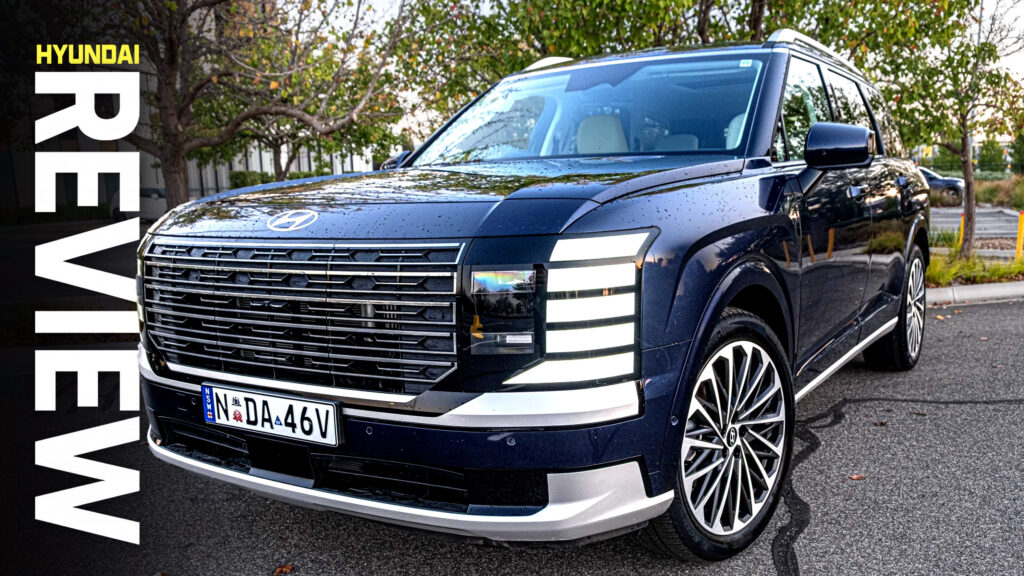
Hyundai has spent the past few years building cars that punch well above their badge, and the latest Palisade is one of them.
When the fifth-generation Santa Fe arrived two and a half years ago, the Range Rover comparisons came fast. That Santa Fe won over critics and consumers alike, praised for its efficient hybrid engine and build quality. If the Santa Fe can be compared to a Range Rover, then the latest Palisade could be viewed as Hyundai’s equivalent to a flagship Range Rover Autobiography, with more performance and an even more impressive cabin.
Review: The 2026 Ioniq 9 Calligraphy’s Biggest Threat Is Hyundai Itself
We spent time with the Palisade in range-topping Calligraphy trim, and it holds up. Every bit as convincing as a Range Rover, and asking a great deal less money for the privilege.
QUICK FACTS
SWIPE
Photos Brad Anderson/Carscoops
In Australia, the new Palisade comes in three flavors: Elite eight-seater, Calligraphy eight-seat, and Calligraphy seven-seat, the last of which is the one we tested. Calligraphy pricing opens at AU$98,338 (US$70,180) for the eight-seater, including all on-road fees, and climbs to AU$99,390 (US$70,900) for the seven-seat. In the US, the Palisade Calligraphy starts at $54,560. And the actual Range Rover Autobiography? It starts north of triple that, around AU$313,000 (US$225,000) in Australia.
Obviously, this flagship version of the Palisade is pricey, but it’s not the most expensive SUV that Hyundai sells. That title is held by the all-electric Ioniq 9 Calligraphy, priced from AU$128,513 ($91,700).
All versions sold in Australia come fitted with the same hybrid all-wheel-drive powertrain. This consists of a 2.5-liter turbocharged four-cylinder engine producing 192 kW (257 hp) and 353 Nm (260 lb-ft) of torque, paired with an electric motor, resulting in a combined output of 245 kW (328 hp) and 460 Nm (339 lb-ft). In the US, shoppers can also order the Palisade with a 3.5-liter naturally-aspirated V6, but it’s capped at a less impressive 214 kW (287 hp) and 353 Nm (260 lb-ft).
The Best Hyundai Interior?
Photos Brad Anderson/Carscoops
Alongside the Ioniq 9, the new Palisade easily has the most luxurious cabin of any current Hyundai model, making this big SUV a joy to live with.
The dashboard is thick and sits high, stretching above the twin 12.3-inch screens. The Santa Fe and the Ioniq 9 have these same screens, but they sit on top of the dashboard. Incorporating them into the dash on the Palisade gives it an altogether more appealing, high-end look.
Positioned below the central infotainment display are a pair of air vents and several large shortcut buttons and toggles, including to change between the various drive modes. Positioned to the left of the air vents are buttons for the Hill Descent Control, parking sensors, and parking cameras, and while we’ll take buttons over touch-screen controls any day, these ones can be a little difficult to reach while on the move.
Photos Brad Anderson/Carscoops
Positioned between the front seats is a gargantuan console with a wireless charging pad, cup holders, and no fewer than three 100-watt USB-C ports. The center console also includes a UV-C sterilization system, similar to the one that premiered on the current Santa Fe, allowing you to kill 99.9 percent of germs on small personal items in just 10 minutes.
The front seats are excellent, offering heated and ventilated options, while the driver’s seat also includes several massage settings. Hyundai’s two-tone Nappa leather steering wheel is also a nice inclusion, as are an excellent 14-speaker Bose audio system and twin sunroofs.
Luxury For All

As we’ve come to expect from Hyundai, the software used across the infotainment and gauge cluster displays is straightforward to operate, includes wireless Apple CarPlay and Android Auto, and offers plenty of configurability.
Our test model was the seven-seater, meaning it ditches a bench in the second row in favor of two captain’s chairs with armrests. In addition to being electrically adjustable, these seats are also heated and ventilated, and are perfect for long road trips. There’s more than enough headroom and legroom for tall adults, as well as manual sunshades.
Read: The 2026 Palisade Has A Second Seat Problem, In Case The First Wasn’t Enough
Much to my surprise, even the third row can accommodate adults. Getting in is as simple as touching a button to get the captain’s chairs to slide out of the way. Once back there, you’ll find that the outboard seats are heated, and there are even additional 100-watt chargers. In addition, the second- and third-row seats can be adjusted and folded away using controls in the trunk. Speaking of the rear, cargo space is 300 liters (10.5 cubic feet) with the third row in place, 712 liters (25.1 cubic feet) with just the second row in place, and 2,081 liters (73.4 cubic feet) with the second row also positioned out of the way.
Big Power For A Big SUV
Photos Brad Anderson/Carscoops
Hyundai could have been excused for fitting the same 1.6-liter turbocharged four-cylinder hybrid as found in the Santa Fe into the larger Palisade. However, doing so would likely have left buyers feeling a little short-changed, given its limited power and the Palisade’s extra size. Thankfully, this isn’t what Hyundai did.
Instead, the 2.5-liter turbocharged four-cylinder hybrid is all-new and much better suited to a vehicle like this. While the Palisade isn’t made for drag races between the lights, it gets moving surprisingly quickly, capable of hitting 100 km/h (62 mph) in a touch under 7 seconds, which is impressive given it weighs up to 2,294 kg (5,057 lbs) as a seven-seater.
The downside of the added poke over the current Santa Fe hybrid is that the 2.5-liter isn’t as whisper-quiet as the 1.6-liter. Although the Palisade will happily cruise on electric power alone at low speeds and during light throttle applications, the four-cylinder engine can be quite noisy when it fires into life. It’s certainly not intrusive, however, and is really only something drivers may notice from time to time.

Once you’re cruising, the overall powertrain works brilliantly. The small electric motor provides that instant hit of power you’d expect, and then the 2.5-liter backs it up with some extra punch. However, I do feel Hyundai could have refined the powertrain even further, as the Palisade does experience a little bit of throttle hang.
The ride of the Palisade Calligraphy is superb. As with most other models that Hyundai sells in Australia, it spent considerable time calibrating the suspension to suit local roads. Although it’s a passive system and doesn’t offer any adjustability, which is somewhat of a shame at this price point, the Palisade soaks up bumps beautifully, despite the sheer size of the thing.
Importantly, the Palisade never feels floaty like some of the competition, including the Mazda CX-90. For example, after taking speed bumps at speed, the Palisade’s suspension settles almost instantly, providing an excellent sense of surefootedness.
Photos Brad Anderson/Carscoops
As you’d imagine, the Palisade isn’t the type of SUV that you’ll take to a twisty mountain road aiming to have fun. Given how soft the ride is, there’s loads of body roll through corners, but this is to be expected. We’re also doubtful any owners will buy a Palisade expecting it to handle like a sporty SUV.
Overall refinement from behind the wheel is excellent. Wind and tire noise have been kept to a minimum thanks to double-laminated windows, and this thing can crunch motorway miles for hours and hours on end, all in supreme comfort while you enjoy a massage. For as nice as it is to have massage functions, the system only provides a faint amount of pressure, so don’t expect it to get those knots out of your back.
Review: 2025 Hyundai Santa Fe Steps Up In All Areas
Throughout my time with the Palisade, I drove alongside plenty of suburban roads and over 200 km on highways, ultimately averaging 8.0 l/100 km (29.4 US mpg). This is a little more than the 6.8 l/100 km (34.5 US mpg) quoted by Hyundai, but it’s certainly not excessive. It’s also not far off the smaller Santa Fe, which usually sits around 6.5-7.2 l/100 km (36 – 32.6 US mpg) over the combined cycle in our previous tests.
In tight city roads, there’s no denying that the Palisade feels big, even though it’s not significantly larger than its predecessor. It has a relatively tight 11.94-meter (39.1-foot) turning circle, but I think it’d greatly benefit from a small amount of rear-wheel steering, boosting maneuverability even further.

Verdict
Not only has Hyundai succeeded in building a large, seven- or eight-seater SUV that deserves to be considered over far more expensive competitors, but the Palisade is perhaps the best vehicle for large families it currently sells.
Sure, if you really want an EV, the Ioniq 9 makes more sense, but it’s significantly more expensive than the Palisade Calligraphy and isn’t much more enjoyable to drive. Additionally, the cabin of the Palisade feels every bit as plush as the Ioniq 9’s, and the hybrid powertrain will suit a much broader range of buyers. It’s also a better buy than competitors like the Mazda CX-90 and Toyota Grand Highlander/Kluger, and is one of the rare vehicles in its segment that actually feels special to drive.