










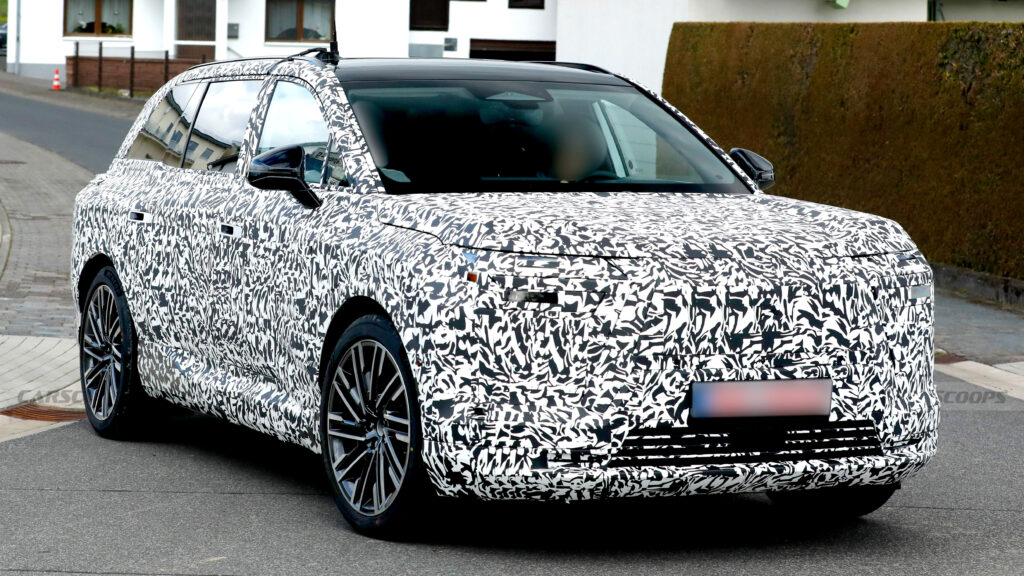
- Lexus is preparing a three-row electric flagship to take on Volvo and Hyundai rivals.
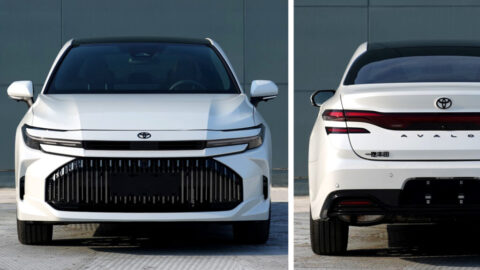
- The TZ shares its overall shape and proportions with the new Toyota Highlander EV.
- Powertrain choices may follow Toyota’s setup, though upgrades are likely.
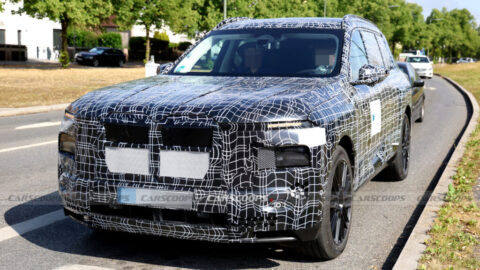
After plenty of speculation about its existence, Lexus’s long-expected electric three-row SUV has surfaced in the open at last. Spied testing for the first time, it is, at heart, a more polished take on the new Toyota Highlander EV, positioned to square up against the Hyundai Ioniq 9, Kia EV9, and Volvo EX90, with a ‘9’ set to feature in its name.
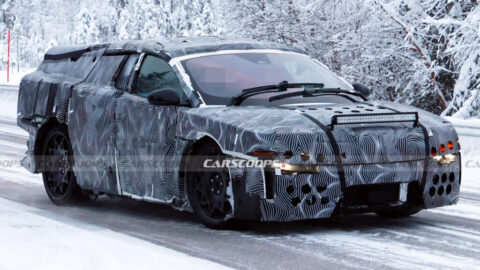
While this prototype is covered from head to toe in camouflage, we can see it retains the same overall shape and profile as the Highlander, though Lexus has worked over the details. Up front, for example, there are split headlights and a cleaner, less cluttered bumper design.
Read: Subaru’s Next SUV Is Big, Electric, And Very Toyota
Cast your eyes down the sides of the TZ, and you’ll notice the wheel arches are slightly more square than they are on the Highlander, and it sits on new wheels, too. The door handles and side windows also look the same as the Toyotas’, although the door skins look a little different.
The rear remains carefully disguised, offering little beyond hints. The taillights appear to mirror the Highlander’s general shape, possibly stretching further down the sides, though for now, most of the detail stays under wraps.
Baldauf
With a few possible exceptions due to the different body panels, the Lexus TZ should have largely the same dimensions as the Highlander. That means it should be about 198.8 inches long, 78.3 inches wide, and stand 67.3 inches, complete with a 120.1-inch wheelbase.
With a few allowances for its unique bodywork, the Lexus TZ or TZ9 if the naming structure holds, is expected to mirror the Highlander’s footprint quite closely. That points to an overall length of roughly 198.8 inches, a width of 78.3 inches, and a height of 67.3 inches, riding on a 120.1-inch wheelbase.
What About The Powertrain?
As for what sits underneath, the safest assumption is that Lexus will lean heavily on Toyota’s existing hardware. In Highlander form, the base setup pairs a 77 kWh battery with a single motor producing 221 hp and 198 lb-ft (268 Nm). Step up to all-wheel drive and output rises to 338 hp and 323 lb-ft (438 Nm), alongside a larger 95.8 kWh battery and a claimed range of up to 320 miles (515 km).
SB-Medien
Although those figures would pass muster for a Lexus, the competition has already moved on. The Volvo EX90 carries a 111 kWh battery, while the Hyundai Ioniq 9 comes in at 110.3 kWh, both pushing for longer real-world range. Against that backdrop, a larger pack for the TZ would not go amiss.
A Familiar Lexus Cabin
We don’t yet have any photos of the TZ’s interior, though a couple of shots show the door panels. They’re clearly different from the doors of the Highlander and appear to have the same electric door release button as other Lexus models.
While some reports suggest it could be built alongside the Highlander EV at Toyota’s plant in Georgetown, Kentucky, others point to production in Japan with exports to global markets, including the US. Either way, it is expected to debut toward the end of the year or in early 2027.