









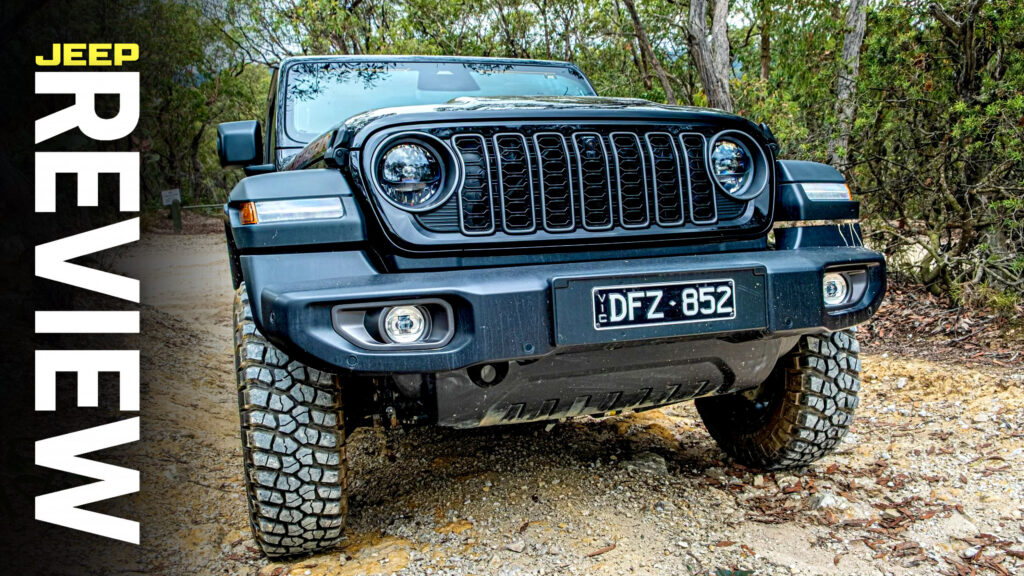
Never before has the Jeep Wrangler bucked industry trends as much as it does now. While many car manufacturers are focusing on electrification and on making new models more connected, automated, and technologically advanced than ever before, the Wrangler retains all the original appeal that has made it iconic.
You won’t find a tablet glued to the dashboard here, or menus replacing simple functions. Even in 2026, the Wrangler sticks with proper buttons and physical controls you can actually use without thinking. Underneath, it’s still built the old-fashioned way too, with body-on-frame construction that prioritizes real off-road ability, yet remains surprisingly livable day to day.
Read: The V8-Powered Jeep Wrangler Just Got $10,000 Cheaper
Set against a sea of quiet, cushioned, tech-heavy crossovers, the 2026 Jeep Wrangler feels unapologetically old-school. The question is whether that’s a strength or just stubbornness. Let’s take a closer look.
QUICK FACTS
SWIPE
Classic Appeal
Photos Brad Anderson/Carscoops
Jeep has been building the current Wrangler since 2017, so it’s getting quite old. Significant updates have been few and far between, yet it still sells in incredible numbers, particularly in the United States. Last year, 167,322 units were sold in its home market, a decline from 2024 and 2023.
We recently sampled the 2026 model in Australia in flagship Rubicon guise in what is perhaps the best configuration for off-roading: two-door guise. Jeep has never sold Wrangler in Australia with the 4xe hybrid or V8 engines it’s offered with elsewhere, and up until recently, the 3.6-liter naturally-aspirated Pentastar V6 was the only option.
Things have changed. The V6 has been ditched from the range and replaced with a 2.0-liter turbocharged four-cylinder. It’s down slightly on power from the 3.6-liter, producing 200 kW (268 hp) compared to the V6’s 209 kW (280 hp), but the turbo helps to increase torque from 367 Nm (271 lb-ft) to 400 Nm (295 lb-ft).
Mated to this engine is an eight-speed automatic transmission and a four-wheel drive system. All the off-road goodies you’d expect have been retained despite the smaller engine, including locking front and rear differentials, solid Dana axles, and a disconnecting sway-bar.
Pricey But Premium?
Photos Brad Anderson/Carscoops
While the Wrangler has remained fairly traditional over the past decade, the Rubicon model has gotten pricey. In the US, it starts at $48,660 in two-door guise, but in Australia, it commands a heftier AU$81,990 ($56,000) price tag. Upgrade to the four-door, and you’re looking at $84,990 ($58,200).
For as old as the Wrangler’s cabin is, it somehow doesn’t feel outdated, which really surprised me.
The central infotainment screen has grown from as small as 5 inches to the current 12.3-inch display. The Uconnect 5 software is nice and comprehensive, with loads of different menus, settings, and adjustments just a few taps away. As in other Jeep models, it remains a good system, even if it’s far from class-leading. Having wireless Android Auto and Apple CarPlay is also a welcome touch.

The Wrangler’s ability to perfectly tread the line between modern and classic is evidenced by the part-digital, part-analog gauge cluster, which came as a welcome reprieve from the more advanced, but cheap-looking, all-digital setups that are becoming common.
Overall, the fit and finish of the cabin is good, to the point where you almost feel a little bad getting the interior dirty, even though this is a Jeep and wouldn’t seem out of place covered in filth 24/7. There’s a nice mix of soft-touch leather and black plastic throughout, with bright red contrast stitching.
The Oddities
Photos Brad Anderson/Carscoops
Some things do take a little getting used to, like the window switches being in the center of the dash, since the doors can be removed with just a few screws. The door aperture is also quite small, so taller drivers will need to duck their heads when getting in or out, or risk slamming into the roof pillar. There’s also no dead pedal for your left foot, so it ends up resting almost under the brake pedal.
It’d be nice for Jeep to add a wireless smartphone charger to the Wrangler, as it’s one of the most obvious modern car conveniences it’s missing. The front seats are also rather uncomfortable, providing very little bolstering and limited lumbar support, making them feel more like church pews than the seats of a car worth over AU$80,000 ($55,600).
Review: The Jeep Wrangler 392 Is A Muscle Car That Can Rock Crawl
While the two-door configuration may make you believe the Wrangler would be completely impractical for any more than two people, that’s not actually the case. Admittedly, clambering into the second row is challenging, but once you’re in, there’s plenty of head and leg room.
The real impracticality of the two-door lies in its cargo capacity, as it offers just 365 liters (12.8 cubic feet) of storage with the rear seats in place. But I’m willing to bet most two-door Wrangler owners keep those seats folded down, or remove them entirely.
Turbo Four
Photos Brad Anderson/Carscoops
I’ve driven plenty of Wranglers before, but this was my first time experiencing the new 2.0-liter turbo-four. The difference it makes to the driving experience cannot be overstated.
Whereas the old Pentastar V6, dating back to 2011, has a somewhat guttural growl and feels rather meaty, the 2.0-liter is much quieter and less obtrusive. Admittedly, it doesn’t feel like it has quite as much low-down torque as the 3.6-liter, and you do need to rev it to get the turbocharger working. When you are up to speed and lift off the throttle, there’s a nice whoosh from the turbo.
One of the main advantages of the 2.0-liter is its improved fuel efficiency. Or, at least it should be. The old V6 had a claimed combined consumption of 10.3 l/100 km (22.8 US mpg), whereas this model is rated at 9.7 l/100 km (24.2 US mpg). However, I averaged 12.6 l/100 km (18.6 US mpg) for the week in the four-cylinder, despite doing plenty of highway driving, where it should have been at its most efficient. Admittedly, some off-roading did increase that average.
Photos Brad Anderson/Carscoops
On the road, the Wrangler 2-Door feels perfectly adequate for everyday use, if a little odd to drive. Owing in large part to the mud-terrain tires and the recirculating ball steering, it feels incredibly vague in the first few degrees of steering, as if nothing is happening. It then gets a little heavier and starts to feel a little more natural.
It also requires plenty of steering lock-to-lock, so you’ll always be hurriedly shuffling the wheel while making turns, particularly in car parks. A key perk of the two-door is its excellent turning circle, thanks to the 2,459 mm (96.8-inch) wheelbase. This isn’t only handy on the road, but also for owners who’ll inevitably take their Wranglers off-roading.
Still Off-Road Royalty

As you’d imagine, the Wrangler’s bread and butter remains off-roading, and this is an area where it continues to be a class-leader.
We took the Jeep on several different trails, heading through muddy ponds, along narrow, bumpy gravel tracks, and up some steep, rocky climbs, all without ever needing to go into 4Low, lock either differential, or deactivate the sway bar. Left simply in 4H Auto, the 2026 Wrangler continues to live up to the Trail Rated name as well as it ever has. It’s hardly a surprise, then, that Wranglers easily outnumbered all other 4x4s I saw throughout the day.
While the Jeep offers plenty of articulation and has suspension tuned for off-roading, that doesn’t mean it soaks up bumps with the same remarkably ability as something like the Ford Ranger Raptor. Indeed, it remains noticeably firm, but is never uncomfortable.
Verdict
Photos Brad Anderson/Carscoops
The Jeep Wrangler has always been quite single-focused in its nature, offering unrivaled off-roading capabilities that were barely ever challenged, until Ford decided to revive the Bronco.
In 2026, the Wrangler retains the same credentials and character of its predecessors, and the 2.0-liter turbo helps to make it feel a little more polished on the road. Make no mistake, the tire roar and wind noises are immense, particularly at highway speeds, and there are better ways to spend your money if you’re after a comfortable and practical daily driver.
Despite its foibles, the Wrangler remains incredibly appealing to those who can afford it. It’s just a shame Australia doesn’t get the V8.