








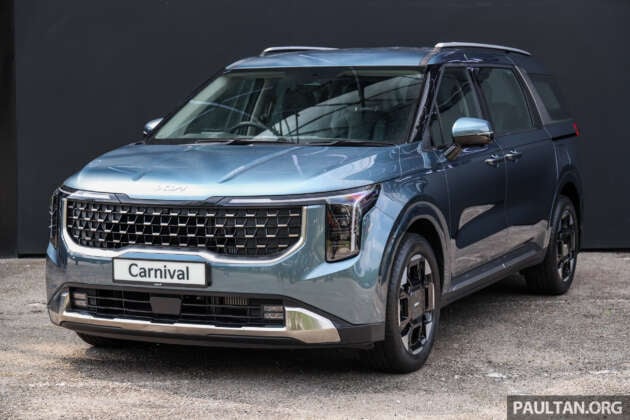
Kia Sales Malaysia (KSM) has launched its first model since taking over the brand’s distributorship on January 1. The facelifted Kia Carnival arrives some two years after its global reveal and three months after it was launched in Thailand, but hey – better late than never, right?
Just like in the Land of Smiles, our Carnival continues to be CKD locally assembled at the Inokom plant in Kulim, Kedah. This time, the MPV is only offered with either 11 or seven seats, with the eight-seater model having been dropped. Nett prices excluding on-the-road costs and insurance but including KSM’s new five-year/150,000 km warranty are as follows:
- 2026 Kia Carnival 2.2D 11-seater – RM188,888
- 2026 Kia Carnival 2.2D 7-seater – RM248,888

With on-the-road costs included, the prices rise to RM189,849 for the 11-seater and RM249,849 for the seven-seater. Compared to the previous Carnival, the new 11-seater model is nearly RM8,700 cheaper than before, while the seven-seater costs over RM10,000 less – staying true to KSM’s goal of “right-pricing” its models. We should point out, however, that the seven-seater is nearly RM30,000 more expensive than the 2025 model when the latter was discounted at the start of the year.
Despite the hybrid version already being built here for the Thai market, the Malaysian-spec Carnival soldiers on with the same diesel engine as before. This means private buyers will still be saddled with high fuel costs with the government’s shift to targeted diesel subsidies.
That oil burner is a 2.2 litre Smartstream D turbo four-cylinder producing 202 PS at 3,800 rpm and 440 Nm of torque from 1,750 to 2,750 rpm. It drives the front wheels via an eight-speed automatic gearbox, and Kia claims an NEDC-rated fuel consumption figure of 6.5 litres per 100 km for this 2.1 tonne behemoth.


Setting the facelifted Carnival apart from the outgoing model is a new front fascia with a much wider “tiger nose” grille, flanked by L-shaped LED headlights – with four-a-side vertical “cube” projectors – incorporating Kia’s latest Star Map LED daytime running light graphic. The bumper design has also been simplified with a single downturned air intake framed by a silver U-shaped skid plate and LED fog lights.
At the rear, you get new full-width LED taillights with the same Star Map graphic, while the number plate recess has been moved further down the tailgate, allowing for a larger space for the Kia emblem to sit. The rear bumper has also been redesigned with a silver bar to match the front.
Both models come with roof rails and a key-detecting hands-free opening function for the powered sliding doors and tailgate (the latter closes when you walk away, too). But they differ in the wheels being offered – 18-inch two-tone turbine-style items for the 11-seater, 19-inch rollers with a distinctive “cubic” design for the seven-seater. The 11-seater also continues to get the taller door mirrors that the seven-seater lacks.

Inside, the changes are more minimal, with the 12.3-inch instrument and infotainment displays now integrated into a single curved display. The two screens are now fitted as standard – no more analogue gauge cluster as was fitted to the previous 11-seater.
Running them is an updated Connected Car Navigation Cockpit (ccNC) infotainment system, which is faster and features wireless Apple CarPlay and Android Auto. Also fitted is a full-width ambient lighting strip under the full-width air vents, while the audio and air-con controls have been combined into a single switchable touch panel as per the EV6, freeing up space for a larger storage cubby. Elsewhere, the seven USB ports throughout the vehicle are now of the USB-C kind.


The cabin is configured in a 2-3-3-3 seating layout for the 11-seater and a 2-2-3 layout for the seven-seater. The latter’s second-row power-adjustable captain’s chairs come with a one-touch Premium Relaxation recline function and can be slid manually either fore and aft or side to side. On both variants, the front seats are eight-way power adjustable with lumbar adjustment (the seven-seater gains driver’s side four-way lumbar adjustment, memory, heating and ventilation).
Standard kit includes keyless entry with remote engine start, push-button start, triple-zone auto air-con with third-row air vents, an auto-dimming rear-view mirror, faux leather upholstery, second- and third-row side window sunshades, paddle shifters, a Qi wireless charger, six speakers and a 360-degree monitor. The seven-seater adds a head-up display, genuine leather and a 12-speaker Bose sound system, although the old car’s dual sunroofs have been dropped with the facelift.


Frustratingly, KSM has still seen fit to reserve driver assists to the seven-seater, even basic functions such as autonomous emergency braking – now outfitted with junction turning collision avoidance, at least. Other features include adaptive cruise control with stop and go, lane centring assist, blind spot monitoring with collision avoidance, blind spot cameras, rear cross traffic alert with auto brake and a driver attention monitor.
Eight airbags – including a driver’s knee airbag and a new front centre airbag – and stability control are standard fitment, as is a door opening warning and a rear seat reminder.
GALLERY: 2026 Kia Carnival 2.2D 11-seater facelift in Malaysia


GALLERY: 2026 Kia Carnival 2.2D 7-seater facelift in Malaysia


GALLERY: 2026 Kia Carnival facelift official photos


GALLERY: 2026 Kia Carnival facelift brochure


The post 2026 Kia Carnival facelift in Malaysia – still 2.2L diesel, 11 or 7 seats, ADAS on 7-seater, priced from RM189k appeared first on Paul Tan’s Automotive News.